
 Promotions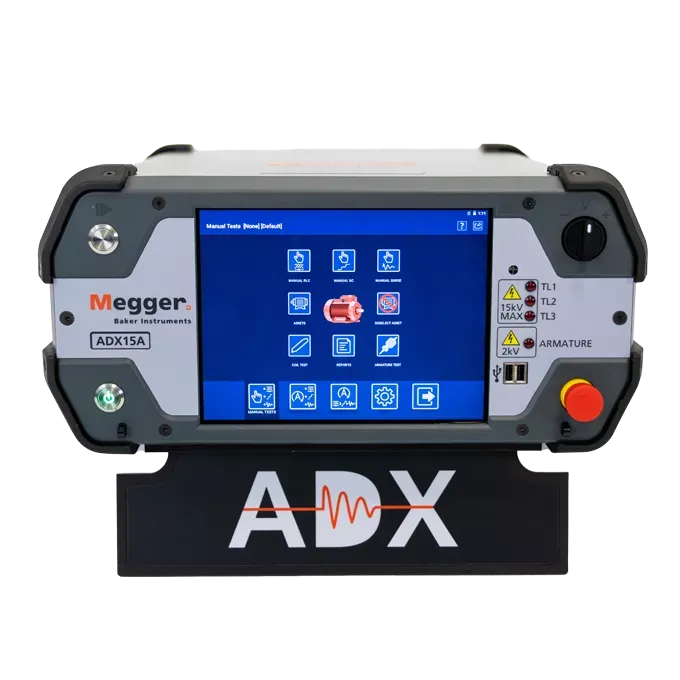



The Hidden Cost of Unplanned Motor Failures
An unplanned electric motor failure in an industrial facility isn’t just an inconvenience — it can mean production downtime measured in tens of thousands of dollars per hour. For maintenance engineers responsible for pumps, compressors, conveyor drives, and HVAC systems, the question isn’t whether motors will degrade; it’s whether you’ll catch the warning signs early enough to act on them.
The problem with traditional motor testing is fragmentation. Engineers commonly need to swap between multiple instruments — an insulation tester here, a surge tester there, a separate low-voltage resistance bridge somewhere else — before they can form a complete picture of winding health. Every lead change is a source of error. Every additional instrument is another thing to calibrate, maintain, and carry to site. And without consistent, structured data collection, identifying degradation trends over time becomes guesswork.
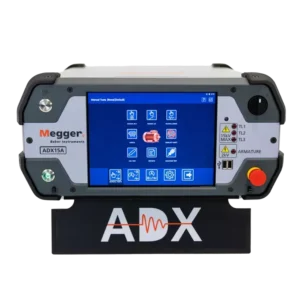
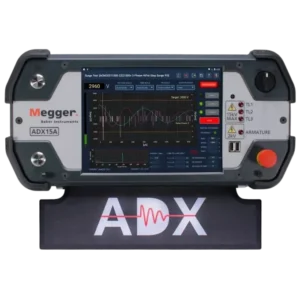
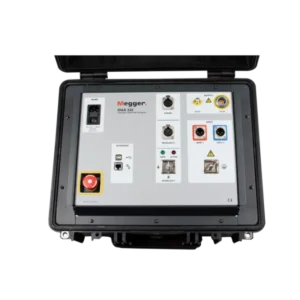
The Megger Baker ADX was engineered to solve exactly that. It consolidates every essential motor winding test into a single, portable analyser — from high voltage surge and partial discharge through to DC hipot, insulation resistance, and low-voltage winding resistance, inductance, and capacitance — with a cloud-connected data management system that makes trend analysis genuinely practical rather than a spreadsheet exercise.
What the ADX Tests — And Why It Matters
The ADX performs a comprehensive suite of static (offline) winding tests across both high-voltage and low-voltage domains, depending on the model configuration selected:
High Voltage Tests (all models)
- Insulation Resistance (IR), Dielectric Absorption (DA), and Polarisation Index (PI): These three tests together paint a thorough picture of winding insulation condition. PI and DA ratios reveal whether insulation is contaminated or deteriorating, making them indispensable for any predictive maintenance programme targeting winding failures before they occur.
- DC HiPot (standard, step voltage, and continuous ramped): High-potential testing applies voltage stress to confirm insulation integrity up to the test voltage ceiling. Step-voltage and ramped variants allow engineers to push windings systematically to identify voltage breakdown thresholds without guesswork.
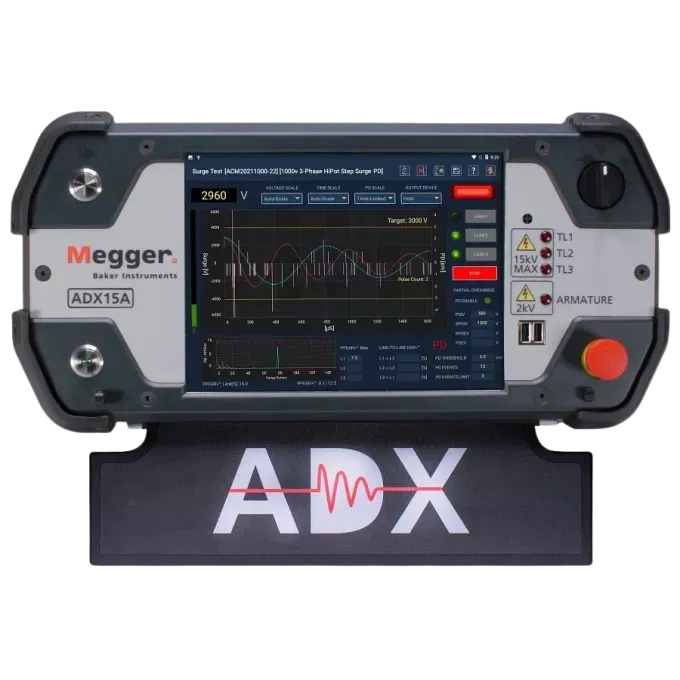
- Surge Analysis with EAR+™: The surge test is the gold standard for detecting inter-turn insulation faults — the kind that often go undetected in DC tests but cause catastrophic in-service failures. The ADX’s EAR+ (Error Area Ratio) analysis including both Pulse-to-Pulse and Line-to-Line comparison provides sensitive, quantified fault detection across all phases.
- Partial Discharge on Surge (optional): The ADX-RLC-PD models add offline partial discharge measurement during surge testing, with PDIV and PDEV values measured per IEC 61934. This is particularly valuable when assessing form-wound coils in high-voltage generators and large motors where PD activity precedes insulation failure by years.
Low Voltage Tests (RLC models)
- Winding Resistance: Four-wire measurement with up to 10 A test current and accuracy of ±2% ±0.25 mΩ, suitable for detecting open circuits, shorted turns, and poor connections.
- Inductance: Tested at 120 Hz and 1000 Hz, covering a measurement range of 0.01 μH to 10 H, enabling winding symmetry checks across phases.
- Capacitance: Measured at 4000 Hz with 0.01 nF to 50 μF range, useful for characterising winding condition in conjunction with other LV parameters.
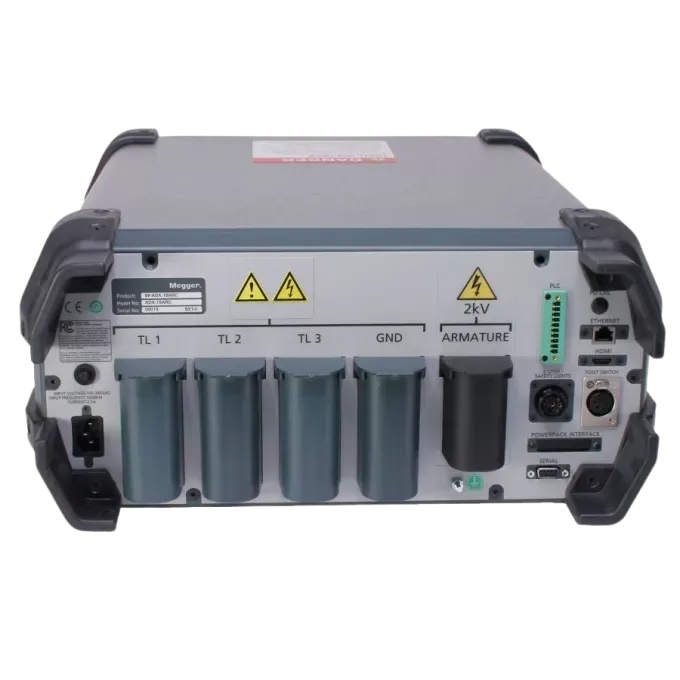
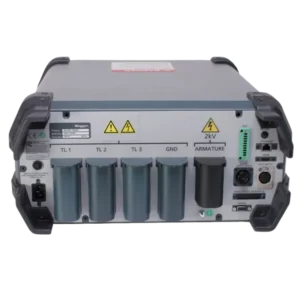
A single set of IEC 61010-compliant 4 m Kelvin test leads connects for all tests — no lead swap between HV and LV modes. That’s a practical time saver that also eliminates a common source of connection error during multi-test sessions.
Four Voltage Models, One Testing Platform
The ADX series is available in four voltage ceiling variants to match the assets you’re testing:
| Model | Max Test Voltage | Typical Application |
|---|---|---|
| ADX 4 | 4 kV | Low-voltage motors, small industrial drives |
| ADX 6 | 6 kV | Medium-voltage motors up to 3.3 kV |
| ADX 12 | 12 kV | High-voltage motors and generators to 6.6 kV |
| ADX 15 | 15 kV | High-voltage assets up to 11 kV |
| ADX + PPX | Up to 40 kV | Extra-high voltage coils and generators |
Each voltage model is available across four configuration tiers: Standard (HV tests only), RLC (HV + low-voltage winding tests), RLC-PD (adds partial discharge), and RLC-PD-PPI (adds Power Pack Interface for use with external PPX units). This modular structure means you only pay for the capability your programme actually requires, with the option to upgrade configurations over time.
Built for the Demands of Industrial Field Work
Motor testing doesn’t happen in a clean lab. It happens in noisy switch rooms, outdoor substations, cramped equipment bays, and motor repair workshops where dust, heat, and grease are facts of life. The ADX was designed with this reality in mind.
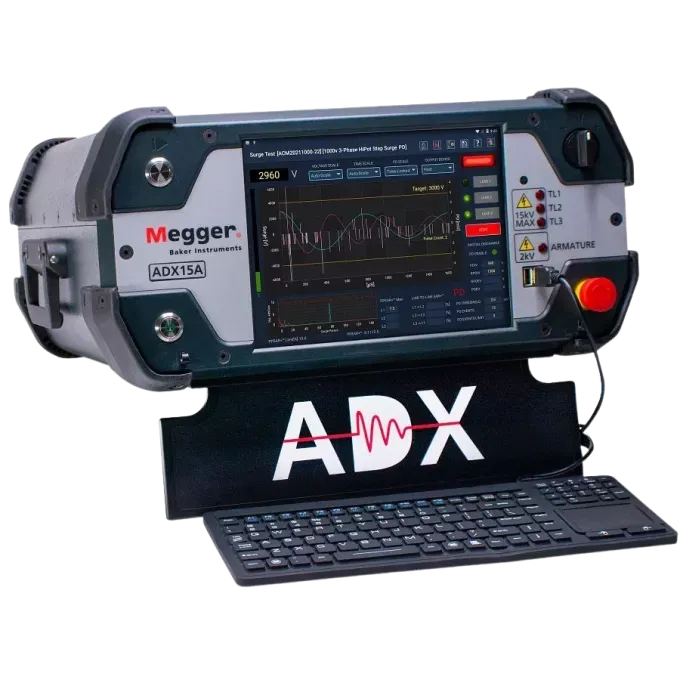
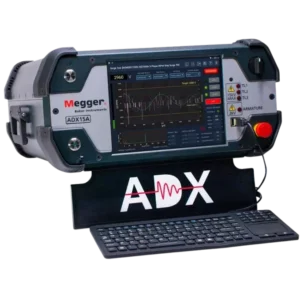
The 10.4-inch daylight-viewable colour touch screen (XGA 1024×768 resolution) remains readable even in direct sunlight — a consistent frustration with lesser instruments on outdoor sites. The industrial IP68 waterproof silicone keyboard with integrated mousepad allows full data entry even when the operator is wearing insulated electrical safety gloves. For situations where hands-free operation is required (such as coil-by-coil bar-to-bar testing on armatures), the optional ADX-FSW footswitch works in parallel with the front panel test switch, keeping the operator’s hands on the test leads.
The ADX-EQS remote test status indicator and E-Stop provides an additional safety layer: a flashing red light confirms active testing is in progress, while a green light indicates the circuit is safe. This is particularly valuable when working with a crew where not all members are positioned at the instrument.
An internal battery backup rated for 4+ hours of standby time ensures the unit can be transported between assets — across a large plant floor or between generator bays — without the need to fully power down, protecting in-progress data and maintaining configuration state.
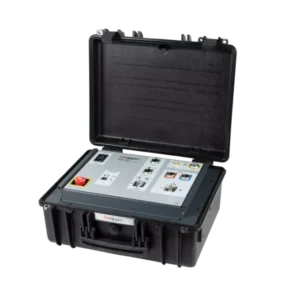
The unit weighs 21 kg and measures 457 × 584 × 216 mm with a foldable integrated viewing stand, and connects via dual-band Wi-Fi (802.11 a/b/g/n, 2.4/5 GHz), Gigabit Ethernet, two USB 2.0 ports, and HDMI for secondary display output.
PowerDB Dashboard — From Test Data to Maintenance Intelligence
Raw test numbers are only half the picture. The value of a motor testing programme comes from tracking those numbers over time, correlating changes with maintenance history, and making confident call-to-repair decisions before failures occur.
The Megger Baker ADX integrates directly with PowerDB Dashboard, a secure cloud-based application accessible from any internet-connected device. Test results recorded on the ADX are automatically synchronised to the cloud as soon as a network connection is available. Engineers and asset managers can log in remotely to review trend data, compare current results against historical baselines, configure upcoming test routes, and generate reports in MS Word or PDF format.
For sites with restricted internet access, an off-line mode allows data export to USB, upload to a local computer, and report creation via PowerDB Print Engine — so cloud connectivity is a performance enhancer, not a hard dependency.
The route-based testing workflow is a genuine productivity multiplier for large facilities. Routes define which assets are to be tested, in what order, and with what test configuration — turning complex multi-asset programmes into a guided sequence that even a less-experienced operator can execute consistently. Asset configuration can be prepared in advance via Dashboard, pushed to the ADX, and results synchronised back — separating the planning and execution phases of large campaigns.
Optional Integrated Armature Test Hardware
The 15 kV ADX15 model with built-in armature test hardware addresses a specific but important requirement for DC motor and traction motor maintenance: bar-to-bar surge testing of armatures without the need for large, unwieldy external transformer accessories. The armature transformer is integrated directly into the unit, maintaining the test lead simplicity of the standard platform while enabling bar-to-bar impulse testing with the precision required for critical DC armature assessment. The ADX15 with armature hardware is compatible with both 30 kV and 40 kV PPX power packs.
Compliance and Australian Market Notes
The Megger Baker ADX is designed to the following key standards relevant to Australian users:
- IEC 61010-1 / IEC 61010-2-034 — Safety requirements for electrical measurement equipment
- IEC 61010-031:2015 — Hand-held probe assembly safety
- IEC 61326-1 Ed. 2.0 — EMC requirements for measurement and control equipment
- IEC 61934 — Partial discharge inception and extinction voltage measurements
- IEC 62133-2:2017 — Li-Ion battery safety
- IEC 61000 series — EMC immunity (ESD, surge, fast transient, radiated RF, power frequency magnetic field, voltage dips)
Publisher note: RCM/EESS certification for Australian market distribution should be confirmed with Megger’s Australian distributor or supplier prior to publishing. This content assumes import for professional use; verify supply chain compliance status.
Technical Specifications Table
| Specification | Value | Why It Matters |
|---|---|---|
| Test voltage range | 100 V – 4/6/12/15 kV (model dependent); up to 40 kV with PPX | Covers low-voltage motors through high-voltage generators in a single platform |
| Kelvin test lead rating | 16 kV DC peak | Provides HV-rated leads for safe connection to high-voltage assets |
| Test types — HV | IR, DA, PI, DC HiPot (standard/step/ramp), Surge with EAR+™, Partial Discharge on Surge (optional) | Full condition assessment toolkit; no additional HV instrument required |
| Test types — LV (RLC models) | Winding Resistance, Inductance, Capacitance | Enables complete electrical characterisation of winding in one session |
| IR measurement range | 100 kΩ – 1 TΩ | Captures both poor and excellent insulation without range changes |
| Voltage accuracy (DC HiPot) | ±2% ±5 V | Reliable voltage delivery for accurate stress testing |
| Current measurement resolution | 16 pA | Detects very low leakage currents in high-quality insulation systems |
| Current accuracy (0–2 kV) | ±4% ±5 nA | Suitable for sensitive PI/DA measurements on clean windings |
| Overcurrent trip | Adjustable up to 1.2 mA | Protects windings from excessive stress during hipot testing |
| Surge energy (nominal at 15 kV) | 11.25 J | Sufficient energy to stress-test large, high-voltage motor windings |
| Surge capacitance | 100 nF nominal | Consistent energy delivery for repeatable inter-turn fault detection |
| Surge repetition rate | 4 Hz nominal | Enables rapid multi-pulse testing for EAR analysis |
| PD threshold range | 1.0–999 mV (0.1 mV resolution) | Programmable sensitivity for diverse motor insulation classes |
| PD measurement standard | IEC 61934 (PDIV, PDEV, RPDIV, RPDEV) | Aligned to international standards for partial discharge characterisation |
| Winding resistance range | 0.001 Ω – 100 kΩ | Covers everything from large generator windings to small motor coils |
| Winding resistance accuracy | ±2% ±0.25 mΩ | Resolves subtle turn-to-turn resistance imbalances |
| Max resistance test current | 10 A | Drives sufficient current for accurate 4-wire measurement on low-resistance windings |
| Inductance range | 0.01 μH – 10 H (120 Hz); 0.01 μH – 200 mH (1000 Hz) | Spans full range from small coils to large generator windings |
| Capacitance range | 0.01 nF – 50 μF | Characterises winding capacitance across diverse motor sizes |
| Display | 10.4-inch daylight-viewable colour touch screen, XGA 1024×768 | Readable outdoors; large enough for clear waveform analysis in the field |
| Keyboard | IP68 waterproof silicone QWERTY with integrated mousepad | Full data entry capability with insulated electrical gloves |
| Platform | Android with capacitive touch, mouse, keyboard, stylus support | Familiar interface; supports secure PowerDB cloud integration |
| Internal storage | 480 GB SSD + 8 GB MMC | Substantial local result storage for large asset fleets |
| RAM | 2 GB DDR3 | Supports responsive UI and simultaneous waveform display |
| Processor | 1.0 GHz quad-core | Adequate for real-time test control and data acquisition |
| Wi-Fi | 802.11 a/b/g/n dual band 2.4/5 GHz | Enables automatic cloud sync to PowerDB Dashboard from site |
| Ethernet | Gigabit 10/100/1000 Mbps | Wired connectivity option for secure network environments |
| USB | 2× USB 2.0 | Data export, printer connection, firmware update |
| HDMI | Yes | Secondary display output for training or supervision |
| Battery backup | 4+ hours standby | Move between assets without powering down |
| Mains input | 90–264 VAC, 47–63 Hz, 2.5 A, CAT II 300 V | Compatible with Australian 230 V/50 Hz mains supply |
| Operating temperature | 5–40°C | Covers typical Australian industrial site conditions |
| Operating humidity | ≤80% RH at 31°C, reducing to 50% RH at 40°C | Suitable for tropical and coastal industrial environments |
| IP rating | IP40 | Dust protected for use in industrial motor rooms and workshops |
| Dimensions (W × D × H) | 457 × 584 × 216 mm (18 × 23 × 8.5 in) | Portable for field use; fits within standard motor shop bench space |
| Weight | 21 kg (46.3 lbs) | Heavy-duty instrument; transport case and backpack available as accessories |
| EMC standard | IEC 61326-1 Ed. 2.0 | Confirms suitability for use in industrial measurement environments |
| Safety standard | IEC 61010-1, IEC 61010-2-034, IEC 61010-031 | Meets international electrical safety requirements for HV test instruments |
| PD standard | IEC 61934 | Partial discharge measurements aligned to international motor testing practice |
What does the Megger Baker ADX test?
The Megger Baker ADX is an automated static motor analyser that performs a comprehensive range of offline winding tests on electric motors, generators, and coils. High voltage tests include insulation resistance (IR), dielectric absorption (DA), polarisation index (PI), DC hipot (standard, step voltage, and ramp), and surge analysis with EAR+ technology. Depending on the model configuration, it also performs partial discharge testing on surge, and low-voltage tests for winding resistance, inductance, and capacitance. All tests use a single set of Kelvin test leads — no lead changes between tests.
What is the test voltage range of the Megger Baker ADX?
The ADX series covers test voltages from 100 V up to 15 kV, available across four models: ADX 4 (up to 4 kV), ADX 6 (up to 6 kV), ADX 12 (up to 12 kV), and ADX 15 (up to 15 kV). When coupled with a Megger Baker PPX power pack, test voltages can be extended to 30 kV or 40 kV for extra-high voltage motors, coils, and generators.
What is EAR+ surge testing?
EAR+ (Error Area Ratio Plus) is Megger Baker’s proprietary surge test analysis algorithm used in the ADX. When a surge voltage is applied to a motor winding, the resulting waveform is compared to a reference. The EAR+ algorithm quantifies the deviation between test and reference waveforms — expressed as an error area ratio — using both Pulse-to-Pulse and Line-to-Line comparison. A higher EAR value indicates greater inter-turn insulation degradation or fault. This method provides a sensitive, quantifiable measure of turn insulation condition that can be tracked over time to identify gradual deterioration before catastrophic failure.
What is partial discharge testing on motors and why does it matter?
Partial discharge (PD) in motor windings is a low-energy electrical discharge that occurs within or across insulation voids, delaminations, or contaminated surfaces when the local electric field exceeds the breakdown strength of the medium. While a single PD event causes limited damage, cumulative PD activity progressively erodes insulation, ultimately leading to winding failure. The Megger Baker ADX RLC-PD models measure partial discharge during surge testing, capturing inception voltage (PDIV), extinction voltage (PDEV), and their repetitive equivalents per IEC 61934. This allows maintenance engineers to quantify PD activity and trend it over time — flagging windings that are approaching end-of-life before an unexpected failure occurs.
What is the difference between ADX Standard, RLC, RLC-PD, and RLC-PD-PPI configurations?
The ADX is available in four configuration tiers. The Standard configuration includes DC insulation resistance, polarisation index, DC hipot (standard, step, and ramp), and surge tests only. The RLC configuration adds low-voltage winding resistance, inductance, and capacitance testing. The RLC-PD configuration adds partial discharge measurement during surge testing. The RLC-PD-PPI configuration includes all of the above, plus a Power Pack Interface (PPI) for connection to a Megger Baker PPX power pack for testing at voltages up to 40 kV. Each configuration is available at 4 kV, 6 kV, 12 kV, and 15 kV voltage ceilings.
What is PowerDB Dashboard and how does the ADX use it?
PowerDB Dashboard is Megger Baker’s secure, cloud-based analysis and asset management application. The ADX automatically synchronises test results to PowerDB Dashboard whenever an internet connection is available. Engineers and managers can log in from any device to review historical trends, compare current test results against previous measurements, configure asset routes, and generate reports in MS Word or PDF format. Asset configuration can be created or edited remotely via Dashboard and pushed to the ADX before a testing campaign — separating the planning phase from the execution phase and improving workflow efficiency for large fleets.
Can the Megger Baker ADX be used without internet access?
Yes. The ADX operates fully as a standalone offline system. All test results are stored locally on the unit’s 480 GB SSD drive. In offline environments, data can be exported to a USB drive, uploaded to a local computer, and reports generated via PowerDB Print Engine software. Cloud synchronisation with PowerDB Dashboard occurs automatically when connectivity is restored, ensuring no data is lost regardless of site connectivity.


Reviews
There are no reviews yet.