
 Promotions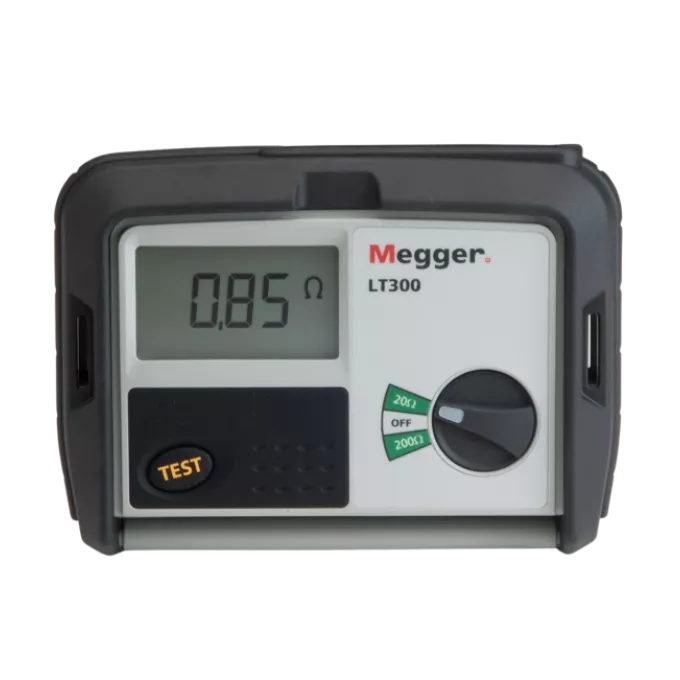


When “close enough” isn’t good enough on loop impedance
Ask any electrician who’s had a loop test come back marginal, then had to explain it to a client or a compliance auditor, and they’ll tell you: confidence in the number matters as much as the number itself. Standard multifunction testers are built to do a bit of everything, and loop impedance is often just one function among a dozen. When you’re dealing with high fault currents, non-standard frequencies, or three-phase distribution boards where accuracy and speed both count, a dedicated high current loop tester earns its place in the van.
The Megger LT300-EN-00 was built around exactly that problem. It’s a dedicated, single-purpose instrument for high current loop impedance testing — no menus to dig through, no mode-switching, just a two-wire connection and a result. For contractors who run loop tests constantly across new installs, periodic inspections, and fault-finding call-outs, that focus translates directly into fewer steps between arriving on site and having a documented, defensible reading.
Built for the realities of loop testing, not just the textbook case
Prospective fault current and loop impedance testing sounds simple in principle — inject a signal, measure the response — but the environments technicians actually work in rarely cooperate. Supply frequency varies depending on the installation (mains, generator supply, or specialised applications). Voltages fluctuate. Job sites are dusty, wet, or poorly lit. And clients increasingly expect test records that hold up to scrutiny, whether that’s an insurer, a facility manager, or a compliance body.
The LT300-EN-00 addresses each of these head-on. It automatically detects supply frequency on connection — 16 Hz, 50/60 Hz, or 400 Hz — and begins testing without any manual configuration, which matters when you’re moving between standard mains work and specialised frequency environments such as rail, marine, aerospace ground power, or certain industrial supplies. The operational voltage range runs from 50 V up to 550 V (400 V at 16 Hz), covering single-phase CAT IV 300 V phase-to-earth work as well as phase-to-phase measurements up to 550 V — with a built-in warning if voltage exceeds 330 V, flagging a possible accidental phase-to-phase connection on what should be a 230 V single-phase circuit. That’s a genuinely useful safety check on Australian 230 V/415 V three-phase systems, where a wiring error at the board can otherwise go unnoticed until it’s too late.
On the display side, the LT300-EN-00 uses a large, high-contrast readout designed to stay legible in poor lighting — switchboard cupboards, roof spaces, plant rooms — and the whole unit sits inside a rubber armoured housing with a built-in cover that protects the display when the instrument isn’t in use. Combined with an IP54 weatherproof rating, it’s built to survive the day-to-day knocks of a working toolbox rather than a lab bench.
Two ranges, two use cases, one tool
The LT300-EN-00 covers loop impedance across two measurement ranges: a 20 Ω range with resolution down to 0.01 Ω, and a 200 Ω range with 0.1 Ω resolution. In practice, that means the same instrument handles both tight, high-current circuits close to a supply — where small resistance changes matter and RCD/PFC calculations need precision — and longer runs or higher-impedance circuits further from the source. Test currents scale with supply voltage and range, from as little as 0.3 A at 50 V on the 200 Ω range up to 27 A at 550 V on the 20 Ω range, giving technicians a realistic picture of prospective fault current under the conditions the circuit will actually see.
Loop test accuracy is rated at ±5% ±0.03 Ω on the 20 Ω range and ±5% ±0.5 Ω on the 200 Ω range — figures worth having on hand when a client questions a borderline result, or when a reading needs to be cross-checked against a previous test.
Two-wire operation: less setup, less to go wrong
The LT300-EN-00 ships with a two-wire (red/green) lead set as standard — no earth lead to route, no third connection point to manage at the board. For technicians running loop tests across dozens of circuits in a single inspection, that simplicity adds up. Fewer connections mean less time per test and less opportunity for a loose or reversed lead to compromise a result. It’s a deliberately stripped-back approach to a task that, done properly, doesn’t need to be complicated.
Who reaches for the LT300-EN-00
Electrical contractors and testing and tagging technicians doing new installation testing, periodic inspection and testing, or fault investigation will find the two-wire workflow suits high-volume loop testing across distribution boards and final sub-circuits, with the 330 V phase-to-phase warning acting as a useful sanity check on three-phase Australian switchboards.
Industrial maintenance teams working around plant with non-standard supply frequencies — including 400 Hz systems used in aviation ground power, some marine environments, and specific industrial machinery — get automatic frequency detection rather than having to manually configure a general-purpose tester for an unusual supply.
Facility managers and compliance-focused teams overseeing scheduled electrical safety inspections benefit from a Certificate of Test supplied with the unit and consistent, repeatable readings that support clear documentation trails for audits and insurance requirements.
Rail, transit, and specialised infrastructure technicians working with 16 Hz or 16.7 Hz traction supply systems have a tool that natively recognises and tests at that frequency without workarounds.
What’s in the box
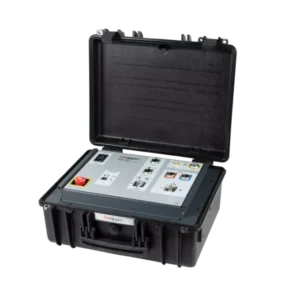
The LT300-EN-00 is supplied with a two-wire (red/green) lead set with crocodile clips, a hard carry case for transport and storage, and a Certificate of Test. It runs on 8 x AA (LR6) alkaline or NiMH rechargeable cells, keeping it independent of mains power for site use.
Backed by a brand technicians already trust
Megger has been a name in electrical test equipment for well over a century, and the LT300 series carries that same design philosophy: purpose-built instruments that do one job precisely rather than many jobs adequately. For Australian trade professionals who need a loop tester that’s ready to work straight out of the case — accurate, rugged, and simple to operate — the LT300-EN-00 is built to earn its place in the kit.
Technical Specifications
| Specification | Value | Why It Matters |
|---|---|---|
| Test type | Loop impedance / high current loop tester | Dedicated single-function instrument, no mode-switching required on site |
| Loop impedance ranges | 20 Ω (0.01 Ω resolution) / 200 Ω (0.1 Ω resolution) | Covers both tight, high-current circuits close to source and longer/higher-impedance runs |
| Loop test accuracy | ±5% ±0.03 Ω (20 Ω range) / ±5% ±0.5 Ω (200 Ω range) | Gives technicians a documented accuracy figure to defend borderline readings |
| Supply frequency detection | Automatic — 16 Hz, 50/60 Hz, or 400 Hz | No manual configuration needed when moving between standard 50 Hz mains and specialised frequency supplies |
| Frequency detection bands | 16 Hz: 15–18 Hz / 33 Hz: 29–337 Hz / 50/60 Hz: 40–70 Hz, 125 Hz, 100–142 Hz / 400 Hz: 260–498 Hz | Broad capture range reduces the risk of a misread or failed detection on non-standard supplies |
| Supply voltage range | 50 V to 550 V (400 V @ 16 Hz) | Suited to single-phase 230 V and three-phase 415 V Australian systems, plus phase-to-phase testing |
| Over-voltage safety category | CAT IV 300 V phase-to-earth / 550 V phase-to-phase (400 V @ 16 Hz), to IEC 61010-1 | Appropriate rating for origin-of-supply and distribution board work |
| Phase-to-phase warning threshold | Alerts above 330 V | Flags a likely accidental phase-to-phase connection on a nominal 230 V circuit — a practical safety check |
| Voltage measurement accuracy | ±2% ±3 V | Confirms supply condition alongside the loop reading |
| Test currents | 0.3 A to 27 A depending on voltage and range (see full table below) | Reflects realistic prospective fault current under actual supply conditions |
| Lead configuration | Two-wire (red/green), standard on LT300-EN-00 | Faster connection, fewer failure points than three-wire setups |
| Display | Large, high-contrast display | Stays legible in dim switchboard cupboards, roof spaces, and plant rooms |
| Housing | Rubber armoured, built-in display cover | Withstands day-to-day knocks in a trade toolbox |
| Ingress protection | IP54 | Protects against dust and splashing water on active job sites |
| Operating conditions | -10°C to +60°C, up to 90% RH @ +40°C | Suited to Australian outdoor and roof-space conditions |
| Storage conditions | -25°C to +70°C | Wide tolerance for storage in a work vehicle |
| Maximum altitude | 2,000 m | Relevant for testing in elevated regional and alpine locations |
| Power supply | 8 x AA (LR6) alkaline or NiMH rechargeable | No mains dependency; batteries are readily available on any job |
| Weight | 980 g (2.16 lb) | Light enough for all-day carry in a service kit |
| Dimensions | 203 x 148 x 78 mm (8 x 5.8 x 3 in) | Compact footprint for a service vehicle or tool bag |
| EMC compliance | IEC 61326-1 | Supports reliable operation around electrically noisy plant and equipment |
| Safety standard | Supports relevant parts of EN 61557 (Part 1 – General Requirements, Part 3 – Loop resistance) | Aligns with the international framework for protective-measures test equipment |
| Included accessories | Two-wire lead set with crocodile clips, hard carry case, Certificate of Test | Ready to test and document results straight out of the case |
| Model variant | LT300-EN-00 (red/green two-wire leads) | Distinct from LT300-EN-BS (BS1363 mains plug lead) and LT300-EN-FS (fused red/green leads) |
Test Current by Voltage and Range
| Supply Voltage | 20 Ω Range | 200 Ω Range |
|---|---|---|
| 550 V | 27 A | 2.7 A |
| 230 V | 12 A | 1.2 A |
| 115 V | 6 A | 0.6 A |
| 50 V | 3 A | 0.3 A |
What is the Megger LT300-EN-00 used for? The Megger LT300-EN-00 is a dedicated high current loop impedance tester used to measure prospective fault current and loop resistance on single and three-phase electrical circuits, using a simple two-wire (red/green) lead connection.
What frequency range does the LT300-EN-00 operate at? It automatically detects and tests at 16 Hz, 50/60 Hz, or 400 Hz, covering standard mains supplies as well as specialised applications such as rail traction supply and 400 Hz aviation or marine systems.
Is the LT300-EN-00 CAT IV rated? Yes. It’s rated CAT IV 300 V for phase-to-earth applications, and supports phase-to-phase testing up to 550 V (400 V at 16 Hz), meeting the requirements of IEC 61010-1.
What’s the difference between the LT300-EN-00, LT300-EN-BS, and LT300-EN-FS? All three share the same core loop tester. The LT300-EN-00 is supplied with a standard two-wire red/green lead set, the LT300-EN-BS comes with a BS1363 mains plug lead for wall socket testing, and the LT300-EN-FS is supplied with a fused red/green lead set.
What resolution does the LT300-EN-00 offer on loop impedance tests? It provides 0.01 Ω resolution on the 20 Ω range and 0.1 Ω resolution on the 200 Ω range, with loop test accuracy of ±5% ±0.03 Ω and ±5% ±0.5 Ω respectively.
What power source does the LT300-EN-00 use? It runs on 8 x AA (LR6) alkaline or NiMH rechargeable cells, so it doesn’t rely on mains power for operation in the field.
How rugged is the LT300-EN-00 for site use? It’s housed in a rubber armoured case with a built-in display cover and carries an IP54 weatherproof rating, and is rated for operation from -10°C to +60°C.


Reviews
There are no reviews yet.