 Promotions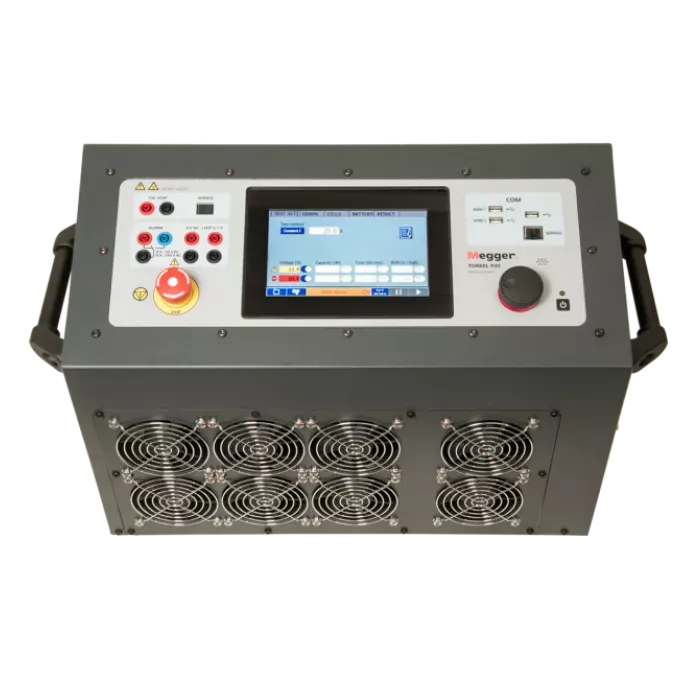


The problem with “assuming” your batteries are fine
Every standby power system — from a substation battery bank to a data centre UPS string — is only as reliable as its weakest cell. The trouble is, a battery can look perfectly healthy on a float voltage reading and still fail catastrophically the moment it’s asked to do its actual job: carry the load during a mains outage. Voltage readings, impedance checks, and visual inspections all have their place, but none of them tell you the one thing that actually matters in an emergency — how much usable capacity is really left in the bank.
That’s the gap a discharge test closes. It’s the only test method that puts a real load on the battery and measures how it performs under the conditions it was bought for. For electrical contractors managing customer standby systems, utility maintenance crews running NERC- or AS/NZS-aligned test programmes, and facility managers responsible for keeping critical infrastructure powered through an outage, a discharge test isn’t a nice-to-have — it’s the evidence that a battery system will actually do its job when everything else has already failed.
The catch has traditionally been logistics. Taking a battery bank offline to discharge-test it means finding a backup, scheduling downtime, and accepting risk exposure while the primary battery system is disconnected. For sites where the battery bank protects live switchgear, telecom infrastructure, or a data hall, that’s often simply not an option.
What the TORKEL900 series actually does
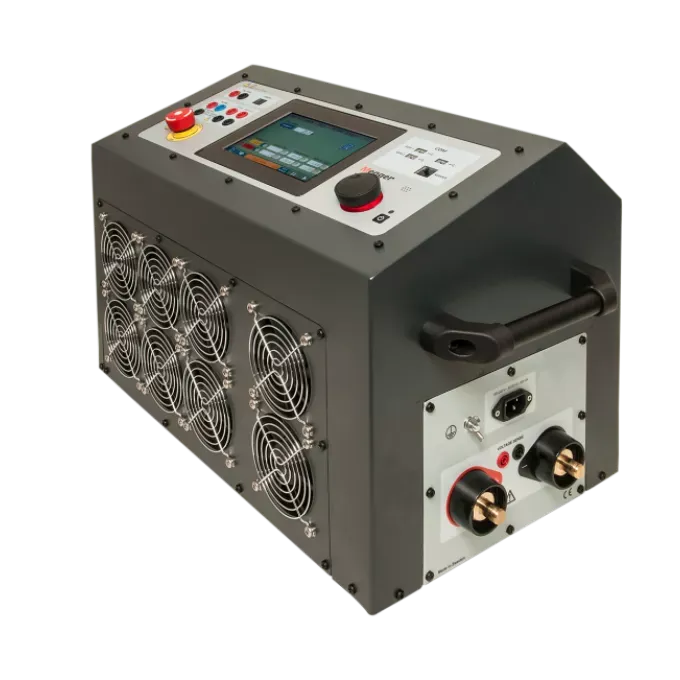
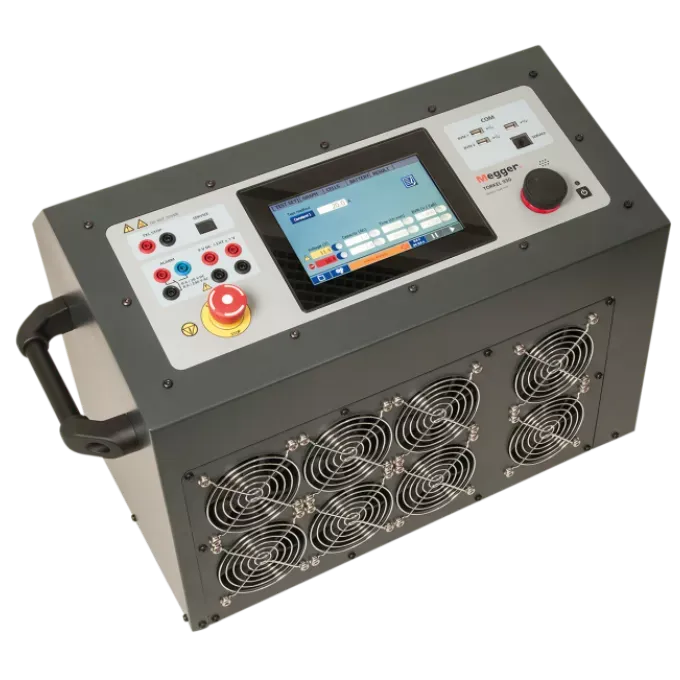
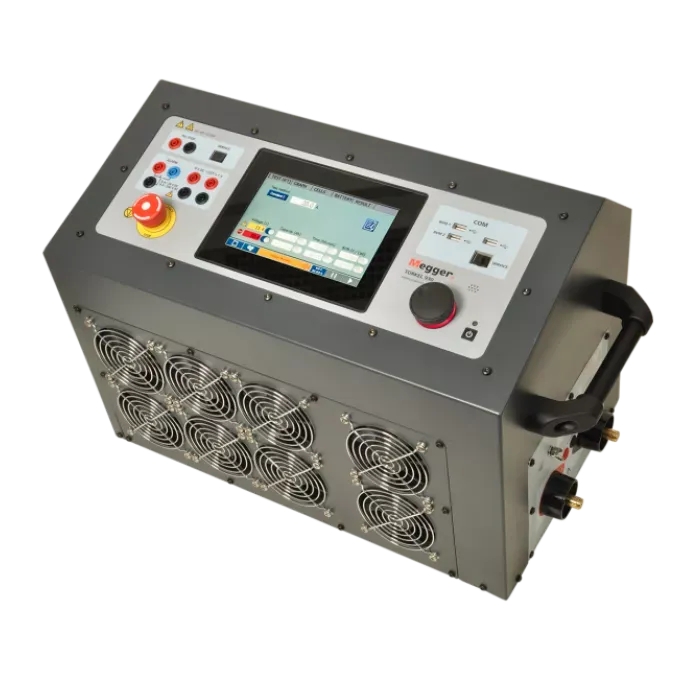
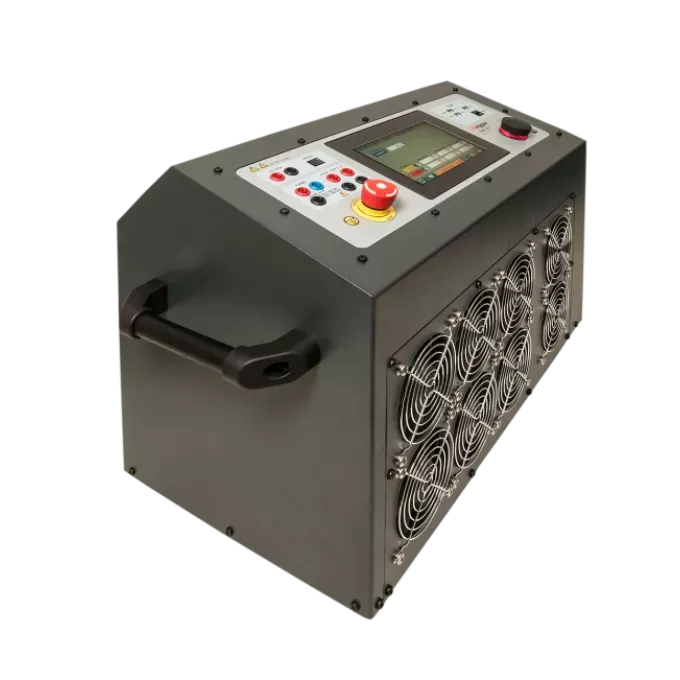
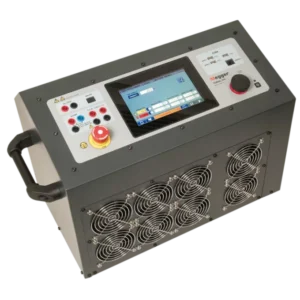
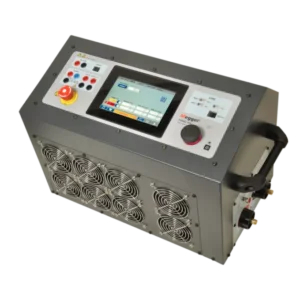
The TORKEL900 series is Megger’s fourth-generation battery discharge test system, built to solve exactly that problem. Rather than requiring the battery to be pulled from service, the TORKEL900 connects directly to the battery bank in place and applies a controlled, regulated discharge — using a DC clamp-on ammeter to measure and hold current at whatever level you set. As the test runs, you watch the voltage curve in real time on the unit’s 7-inch touchscreen, and if the voltage drops toward the point where deep discharge becomes a risk, the TORKEL issues an alarm, and ultimately shuts the test down automatically to protect the battery.
Three load-regulation modes are available depending on how you want to profile the test: constant current, constant power, constant resistance, or a pre-selected load profile that mimics a real duty cycle. That flexibility matters because different battery types and different applications call for different test regimes — a telecom rectifier string being tested against its actual load profile is a very different job to a straightforward capacity check on a switchgear trip battery.
Because the unit works with the battery connected and in service, plus- or minus-grounded, or free-floating systems are all supported without extra rigging. Results — voltage, current, capacity, and time — are logged internally and can be pulled off via USB stick or Ethernet for reporting on a PC using the included TORKEL Viewer software (930/950) or PowerDB.
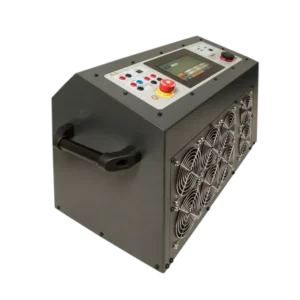
Safety is built into every layer of the design. Blocked-airflow detection prevents the unit from overheating mid-test, the enclosure and connections are designed to be spark-free, and a physical emergency stop is within reach of the operator at all times. For technicians working around live DC battery plant — often at voltages and currents that don’t forgive carelessness — that’s not a footnote, it’s the difference between a routine maintenance task and an incident report.
Faster testing through higher discharge capacity
One of the practical frustrations with older discharge testing gear is how long a proper capacity test takes. The TORKEL900 series addresses this head-on with a high discharge capacity — up to 220 A per unit — which shortens the time needed to pull a meaningful capacity result out of a large battery bank. If a single unit’s current ceiling isn’t enough for the bank you’re testing, two or more TORKEL units, or Megger’s TXL extra load units, can be linked together to push the total discharge current higher still, without needing a second, separate test rig.
Turning it into a complete cell-monitoring system
On its own, the TORKEL900 gives you total bank current, voltage, and capacity. Connect Megger’s BVM (Battery Voltage Monitor) to a TORKEL 930 or 950, though, and the system becomes something more useful again: a complete, standalone discharge and cell-monitoring rig that tracks individual cell voltages throughout the entire test. That matters because bank-level capacity numbers can hide a single weak cell dragging the whole string down. With BVM connected, that weak cell shows up on screen in real time — while there’s still time to plan a bypass and keep the test running, rather than finding out about it after the string has already failed in service.
Choosing between the 910, 930, and 950
The TORKEL900 series isn’t a one-size-fits-all box — Megger built three models specifically so buyers aren’t paying for capability they don’t need, or worse, under-specifying for the battery plant they actually have to test.
TORKEL 910 — for straightforward capacity testing on smaller systems. Rated to 110 A and 300 V, the 910 is the entry point into the series and suits contractors and facility teams running capacity checks on smaller UPS strings, switchgear trip batteries, or standalone standby systems where cell-by-cell monitoring isn’t part of the maintenance regime. It doesn’t support BVM integration or the full PC-based reporting suite, but as a dedicated discharge/capacity tester for smaller banks, it covers the core job at a lower entry cost.
TORKEL 930 — for teams that need the full picture. Stepping up to 220 A while holding the 300 V ceiling, the 930 adds BVM compatibility, charging measurement, and full report functionality through TORKEL Viewer. This is the natural fit for utility maintenance teams, data centre facilities staff, and calibration technicians who need to combine bank-level capacity data with individual cell voltage tracking and produce a proper PC-generated test report as part of a documented maintenance programme.
TORKEL 950 — for high-voltage battery plant. Built for the same 220 A discharge capacity as the 930 but extending the voltage range to 500 V, the 950 is the model to specify for larger substation battery banks, high-voltage telecom plant, and industrial systems where the 300 V ceiling of the 910/930 simply isn’t enough. It carries the same BVM integration and full reporting functionality as the 930, scaled for bigger battery systems.
Across all three models, the underlying test engine, safety systems, and workflow are identical — the difference is current and voltage headroom, and whether BVM cell monitoring and full PC reporting are included. That makes it straightforward to match the unit to the battery plant on site rather than defaulting to the biggest (and most expensive) option out of caution.
Where the TORKEL900 series earns its keep
- Substations and utility battery plant — capacity testing DC trip and control batteries as part of scheduled maintenance programmes.
- Data centres — verifying UPS battery strings can genuinely deliver runtime during a mains failure, without pulling the string offline.
- Telecommunications infrastructure — testing rectifier-fed battery banks against realistic load profiles.
- Industrial and OEM facilities — capacity testing standby and backup power systems supporting critical process equipment.
- Calibration and test labs — running structured, repeatable discharge tests as part of documented battery health trending programmes.
Technical Specifications (TORKEL900 Series)
| Specification | Value | Why It Matters |
|---|---|---|
| Discharge current (max) | TORKEL 910: 110 A · TORKEL 930/950: 220 A | Higher current shortens test time on larger battery banks and reduces how long staff need to be on site for a capacity test. |
| Battery voltage range | TORKEL 910/930: 7.5–300 V DC · TORKEL 950: 7.5–500 V DC | Determines which battery plant the unit can test directly — 950 covers higher-voltage substation and telecom banks. |
| Maximum power | 15 kW | Sets the ceiling on total discharge load a single unit can apply; multiple units or TXL loads extend this further. |
| Load regulation modes | Constant current, constant power, constant resistance, load profile | Lets the test match the battery’s real duty cycle rather than a generic fixed-current discharge. |
| BVM (cell voltage monitor) compatibility | TORKEL 930/950: Yes · TORKEL 910: No | Enables individual cell tracking during the test, so a single weak cell can be identified before it takes the whole string down. |
| Charging measurement | TORKEL 930/950: Yes · TORKEL 910: No | Supports monitoring the battery’s recharge behaviour after test, relevant for full maintenance-cycle documentation. |
| Full report functionality (TORKEL Viewer) | TORKEL 930/950: Yes · TORKEL 910: No (requires paid firmware upgrade) | Produces PC-based test reports suitable for maintenance records and compliance documentation. |
| Test time (max) | 240 hours | Supports extended discharge profiles for large-capacity or slow-discharge battery banks. |
| Number of stored test files | 30 (max) | Lets technicians run and store multiple tests before needing to offload data. |
| Data output | Internal memory, USB, Ethernet | Test results can be pulled to a PC without needing a permanent network connection on site. |
| Display | 7″ capacitive touchscreen | On-screen real-time monitoring of voltage and current during the discharge test. |
| Mains supply | 100–240 V AC, 50/60 Hz | Compatible with standard Australian 230 V / 50 Hz supply without a step-down transformer. |
| Operating temperature | 0 °C to +50 °C | Suited to indoor substation, plant room, and data centre environments; derates above +35 °C. |
| Ingress protection | IP20 | Indicates the unit is designed for indoor/enclosed environments rather than direct outdoor exposure. |
| Dimensions | 519 × 315 × 375 mm | Relevant for transport case sizing and site access planning. |
| Weight (instrument only) | 19.5 kg | A factor for technicians carrying the unit to elevated or hard-to-access battery rooms. |
| Safety protections | Thermal cut-outs, automatic overload protection, emergency stop | Reduces risk when discharge testing live DC battery plant at high current. |
Specifications sourced from the Megger TORKEL900 Series datasheet (Doc. CS033664LE, 2022) and manufacturer product page. Where the datasheet and web page differ in presentation, the datasheet’s figures are treated as authoritative.
What does the Megger TORKEL900 do? The TORKEL900 series is a battery discharge test system that applies a controlled load to a battery bank to measure its actual usable capacity, without needing to disconnect the battery from service.
What’s the difference between the TORKEL 910, 930, and 950? The TORKEL 910 tests up to 110 A and 300 V with basic capacity testing only. The TORKEL 930 raises current to 220 A and adds BVM cell monitoring, charging measurement, and full PC reporting. The TORKEL 950 matches the 930’s features but extends voltage capability to 500 V for larger battery plant.
Can the TORKEL900 test a battery without taking it offline? Yes. The TORKEL900 connects to the battery in service and regulates discharge current via a DC clamp-on ammeter, so the battery bank doesn’t need to be disconnected or replaced with a temporary backup during the test.
What happens if the battery voltage drops too low during a TORKEL discharge test? The TORKEL issues an alarm when voltage approaches the final discharge level, and automatically stops the test if there’s a risk of deep discharge damaging the battery.
Can multiple TORKEL units be linked together for higher current? Yes. Two or more TORKEL900 units, or Megger’s TXL extra load units, can be linked to increase total discharge current beyond a single unit’s rating for larger battery banks.