
 Promotions


When two elements aren’t enough
There’s a specific and expensive mistake that gets made on three-phase measurement: using a two-element meter on a four-wire system.
On a balanced load you might not notice. The numbers look plausible. But the moment the load is unbalanced — and in a real building, a real factory, a real solar installation, it always is — the two-wattmeter method stops giving you correct total power on a four-wire circuit. Current is returning through the neutral, and a two-element instrument has no channel measuring it.
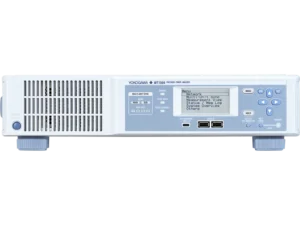
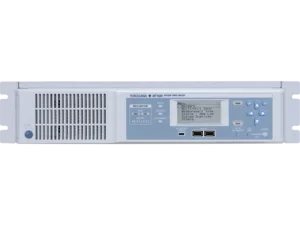
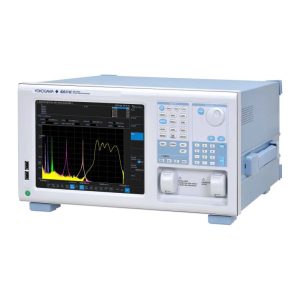
The Yokogawa WT333E digital power meter is the three-element answer. Three voltage inputs, three current inputs, one per phase, with total power calculated as the straightforward sum: P∑ = P1 + P2 + P3.
That’s not a clever algorithm. It’s just having enough channels — and on a four-wire system, three is the number.
Four wiring configurations, one instrument
The WT333E is the most configurable model in the WT300E series, supporting:
Three-phase four-wire (3P4W). The configuration that matters most in Australia. Our distribution standard is 400 V (nominally 415 V) phase-to-phase with a 230 V phase-to-neutral relationship — a four-wire system by design. Every commercial switchboard-fed load, every mixed single-phase-and-three-phase installation, every unbalanced building distribution is 3P4W. Total voltage, current and power are summed across all three elements, giving correct results regardless of balance.
Three-voltage three-current (3V3A). The three-wattmeter method applied to a three-wire system. You don’t strictly need three elements on a three-wire circuit, but 3V3A gives you something two elements can’t: individual voltage, current and power data for each phase, plus improved handling of distorted and unbalanced conditions. Total apparent power is computed as (√3/3)(S1 + S2 + S3).
Three-phase three-wire (3P3W). The conventional two-wattmeter method, if you want it.
Single-phase three-wire (1P3W). Split-phase measurement.
The practical upshot: one instrument on the shelf covers every wiring configuration you’re likely to encounter, and you don’t have to make a purchasing decision about your future measurement problems today.
Per-phase visibility, which is the point
Total power tells you what the system draws. Per-phase data tells you why.
With three elements, the WT333E gives you voltage, current, active power, apparent power, reactive power, power factor and phase angle for each element independently — and frequency measurement selectable from the voltage or current of element 1, 2 or 3.
That’s what turns a power meter into a diagnostic instrument. Phase imbalance that’s overloading one conductor. A power factor problem isolated to one leg. A harmonic issue that only appears on the phase feeding the drives. None of that is visible in a summed total.
Accuracy and bandwidth
Basic power accuracy is ±(0.1% of reading + 0.05% of range) at 45–66 Hz, consistent across all measurement ranges. Yokogawa states that WT332E and WT333E performance matches that of the WT310E.
The influence at power factor 0 is ±0.1% of apparent power between 45 and 66 Hz — half the previous generation’s figure. On three-phase distribution work this is the specification that decides whether your measurement is useful. Reactive-heavy loads, lightly loaded motors, capacitor banks and no-load conditions all sit at low power factor, and at low PF the influence term dominates your total uncertainty.
Bandwidth is DC and 0.1 Hz to 100 kHz, with voltage and current converted simultaneously through a 16-bit A/D at approximately 100 kS/s. Simultaneous conversion is what preserves the phase relationship between the voltage and current channels — and phase error is what destroys power accuracy on any waveform that isn’t a clean sinusoid. Which, on a modern distribution board feeding inverters, LED drivers, UPS units and variable-speed drives, is most of them.
Where the WT333E does work others can’t
Three-phase four-wire distribution measurement. Unbalanced building loads, mixed-phase installations, commercial plant. Correct total power plus per-phase diagnosis.
Unbalanced load analysis. Identifying which phase is carrying the imbalance, quantifying it, and having the per-element data to prove it.
Three-phase efficiency measurement. Efficiency computation is built into the WT333E (as it is on the WT332E, and unlike the single-element WT310E). Measure a converter, transformer, drive or motor input against its output on one instrument, one timebase, one calibration.
Motor and rotating machinery duration testing. Integration runs to 10,000 hours — approximately one year. With the /C7 Ethernet option, Modbus/TCP feeds Yokogawa’s GA10 data-gathering software, which can combine your electrical measurements with temperature, torque and rotation speed data across up to 200 channels. That’s a complete motor test dataset in one logging environment.
UPS conformance and evaluation. Input and output levels, efficiency, frequency and THD, with average active power under integration mode giving a true consumption figure for fluctuating loads.
Harmonic and power quality investigation on three-phase systems. With the /G5 option, PLL-synchronised harmonic analysis to the 50th order on all three elements, with a settable maximum THD order — so you can see harmonic content phase by phase rather than as an aggregate.
Three-phase product development and QA. USB standard, GP-IB (–C1) or RS-232 (–C2) at order, /C7 Ethernet with Modbus/TCP and VXI-11 for recorder and PLC integration, and the /DA12 option for twelve channels of ±5 V analogue output — sized for the parameter count that three elements generate.
Australian context worth knowing
The 3P4W capability is the reason this model matters here. Australian LV distribution is four-wire, and a great deal of commercial and industrial measurement work involves loads that are meaningfully unbalanced. The WT333E’s 300 V and 600 V voltage ranges cover both the 230 V phase-to-neutral and 400/415 V phase-to-phase relationships directly.
Now the important caveat, and it deserves to be blunt: the WT333E is a measurement category CAT II, 600 Vrms instrument. Yokogawa’s documentation states plainly that it is a measurement category II product and must not be used for measurement categories III or IV.
CAT III covers facility circuits — distribution boards and circuit breakers. CAT IV covers power source circuits such as entrance cables. So while the WT333E is the correct topology for four-wire systems, it is a bench, test-rig and machine-terminal instrument, not a switchboard instrument. If your job is measuring at the distribution board itself, you need an instrument rated for that category, regardless of how good this one’s specifications are. That distinction is a safety matter, not a paperwork one.
Order the –R power cord suffix for the AS-standard plug. Supply is 100–240 VAC (90–264 V permitted) at 48–63 Hz, 70 VA maximum.
The instrument is Class A under EN 55011 — an industrial-environment device. Operating it in a residential area may cause radio interference, and correcting that interference is the user’s responsibility.
Why buy the WT333E from us
The three-element decision usually comes down to one question, and it’s worth getting right before you order: does your system have a neutral that carries current? If yes, you need three elements. If no, two will do — and we’ll tell you that rather than sell you up.
We’ll also work through the option codes with you. /G5 harmonics, /C7 Ethernet, /EX1 or /EX2 external sensor input and /DA12 analogue output are factory-fitted at time of order. Getting the configuration right at purchase is considerably cheaper than discovering the gap three months into a project.
We’re a test and measurement specialist. We supply, we support, we calibrate, and we’re around after the sale. Tell us what you’re measuring and we’ll help you spec it.
TECHNICAL SPECIFICATIONS
| Specification | WT333E Value | Why It Matters |
|---|---|---|
| Input elements | 3 | One voltage and current channel per phase — required for correct total power on four-wire systems |
| Wiring systems | 1P3W, 3P3W, 3P4W, 3V3A | Every common configuration, including Australia’s 400/415 V four-wire distribution |
| Per-phase measurement | V, I, P, S, Q, PF, phase angle per element | Diagnose which phase carries an imbalance, not just the total |
| Efficiency computation | Yes (built in) | Input vs output on one instrument, one timebase — not available on the WT310E |
| Basic power accuracy (45–66 Hz) | ±(0.1% of reading + 0.05% of range) | Consistent across all ranges; matches WT310E performance |
| Influence at power factor 0 | ±0.1% of apparent power (45–66 Hz) | Half the previous generation — decisive for reactive and lightly loaded three-phase measurement |
| Frequency bandwidth | DC, 0.1 Hz to 100 kHz | Covers inverter, UPS and switching content across all three phases |
| Current ranges (CF 3) | 0.5 / 1 / 2 / 5 / 10 / 20 A | Six direct ranges per element |
| Current ranges (CF 6 / 6A) | 0.25 / 0.5 / 1 / 2.5 / 5 / 10 A | Doubled headroom for high-crest-factor waveforms |
| Voltage ranges (CF 3) | 15 / 30 / 60 / 150 / 300 / 600 V | 300 V covers 230 V phase-to-neutral; 600 V covers 400/415 V phase-to-phase |
| Continuous max current input | Peak 100 A or 30 A RMS, whichever is less | Real headroom above the rated 20 A range |
| Sampling | Approx. 100 kS/s, 16-bit, simultaneous V and I conversion | No multiplexing phase error — essential for distorted three-phase waveforms |
| Data update rate | 100 ms / 250 ms / 500 ms / 1 / 2 / 5 / 10 / 20 s, or Auto | Auto tracks fluctuating inputs down to 0.1 Hz |
| Frequency measurement | Voltage or current of element 1, 2 or 3 (reciprocal method) | Frequency on any phase you choose |
| Display | 7-segment LED, 4 simultaneous items, 4 or 5 digits | Four parameters at a glance; full parameter set via software |
| Integration | Up to 10,000 hours; ±Wh, ±Ah, average active power, auto ranging in integration | Year-long runs that survive a mid-test load step |
| Harmonics (/G5 option) | Up to 50th order on all installed elements, PLL 10 Hz–1.2 kHz, settable max THD order | Phase-by-phase harmonic analysis, not just an aggregate |
| Communication (standard) | USB 2.0 (USBTMC-USB488) | Free WTViewerFreePlus software included |
| Communication (order code) | GP-IB (–C1) or RS-232 (–C2) | One selected at order to match your ATE |
| Communication (option) | Ethernet /C7 — 10/100BASE-TX, VXI-11, Modbus/TCP, DHCP | Feeds GP10/GM recorders, GA10 software and FA-M3V PLCs |
| D/A output (/DA12 option) | 12 channels, ±5 V FS, 16-bit | Channel count matched to three elements of parameters |
| External sensor input | /EX1: 2.5/5/10 V or /EX2: 50 mV–2 V | Extends measurement above 20 A per phase via clamps or sensors |
| Measurement category | CAT II, 600 Vrms | Bench, rig and machine-terminal use only — not CAT III or CAT IV |
| Safety standards | EN 61010-1, EN 61010-2-030 | Recognised international safety design basis |
| Supply | 100–240 VAC (90–264 V permitted), 48–63 Hz, 70 VA max | Runs on Australian 230 V/50 Hz; order –R for AS plug |
| Dimensions / weight | Approx. 213 (W) × 132 (H) × 379 (D) mm / approx. 5 kg | Half-rack width; rack kits 751533/751534-E3 or -J3 |
| Operating environment | 5–40 °C, 20–80% RH non-condensing, ≤2000 m | Indoor labs, plant rooms and production floors |
| Warm-up time | Approx. 30 minutes | Required before accuracy-critical measurements |
| Included software | WTViewerFreePlus | Setup, capture, trending, up to 200 parameters, up to 4 units |
What is the Yokogawa WT333E used for? The Yokogawa WT333E is a three-element digital power meter used to measure three-phase four-wire (3P4W), three-voltage three-current (3V3A), three-phase three-wire and single-phase three-wire systems. Three elements give correct total power on unbalanced four-wire loads plus individual voltage, current and power data for every phase — making it the model of choice for three-phase distribution measurement, motor and drive efficiency testing, UPS evaluation and phase-by-phase harmonic analysis.
Why do I need three elements instead of two? Because of the neutral. On a three-phase four-wire system, current returns through the neutral conductor, and a two-element instrument has no channel measuring it — so on an unbalanced load, a two-element meter will not give correct total power. Three elements measure each phase independently and sum them (P∑ = P1 + P2 + P3), which is correct regardless of balance. If your system genuinely has no current-carrying neutral, two elements are sufficient and the WT332E will do the job.
Can the WT333E measure 400/415 V three-phase in Australia? Its 600 V range covers 400/415 V phase-to-phase and its 300 V range covers 230 V phase-to-neutral, and the 3P4W wiring configuration matches Australian LV distribution. However, the WT333E is a measurement category CAT II, 600 Vrms instrument and Yokogawa states it must not be used for CAT III or CAT IV measurements. That makes it suitable at machine terminals and on test rigs fed from a fixed installation, but not for measurement at distribution boards, circuit breakers or service entrance cables.
What is the difference between the WT332E and WT333E? The number of input elements. The WT332E has two and supports 1P3W and 3P3W wiring. The WT333E has three and adds 3P4W and 3V3A configurations, plus per-phase data on all three phases and frequency measurement selectable from any of the three elements. Accuracy, bandwidth, current ranges, voltage ranges, physical size and options are otherwise the same.
What is 3V3A and when would I use it? Three-voltage three-current is the three-wattmeter method applied to a three-wire system. You don’t need three elements on a three-wire circuit for total power, but 3V3A gives you individual phase data that the two-wattmeter method cannot, and handles unbalanced and distorted conditions better. Use it when you want per-phase diagnostic detail on a three-wire load. Total apparent power in 3V3A is computed as (√3/3)(S1 + S2 + S3).
Does the WT333E measure harmonics on all three phases? With the /G5 harmonics option fitted, yes — harmonic measurement applies to all installed elements. It uses PLL synchronisation across a fundamental frequency range of 10 Hz to 1.2 kHz, analyses to the 50th order, and allows the maximum order used for THD calculation to be set by the user. Without /G5 the instrument measures RMS, voltage mean and DC values but not harmonic components.
Can the WT333E calculate efficiency? Yes. Efficiency computation is built into both the WT333E and the WT332E. Because both the input and output measurements are taken by the same instrument on the same timebase and the same calibration, you avoid the synchronisation and relative-drift errors that come with running two separate power meters and reconciling their logs afterwards.




Reviews
There are no reviews yet.