
 Promotions


The measurement everyone gets wrong: small power
Ask most labs to measure 500 W and they’ll nail it. Ask them to measure 0.3 W of standby draw on a switch-mode power supply — with a distorted, spiky current waveform and a power factor near 0.1 — and the numbers start to wander.
That’s the problem the Yokogawa WT310E digital power meter was designed around.
Low-power measurement is unforgiving. A general-purpose multimeter or a clamp-based logger simply doesn’t have the resolution or the sampling architecture to resolve sub-watt consumption on a 230 V supply. Worse, the errors aren’t random — they’re systematic, and they tend to under-report. If you’re submitting appliance data for an energy-efficiency claim, a compliance file, or a product datasheet, a systematic error is a liability, not a rounding issue.
The WT310E solves it with genuine measurement engineering rather than clever averaging: a dedicated 5 mA current range, a 16-bit A/D converter sampling both voltage and current simultaneously at approximately 100 kS/s, and a shunt-based floating current input that behaves predictably at the bottom of its range.
What the WT310E actually is
It’s the single-input-element member of Yokogawa’s WT300E family — a half-rack, 213 mm wide, 3 kg benchtop instrument that measures single-phase two-wire (1P2W) circuits.
One element means one voltage input and one current input, wired across a single load. That’s exactly what you want for testing an appliance, a power supply, a battery charger, a set-top box, an LED driver, a small motor or any 230 V single-phase device — which describes the overwhelming majority of product-level energy testing done in Australia.
Yokogawa has been building compact digital power meters since 1979. The WT300E series is the fifth-generation platform in that lineage, and the “E” revision lifted the basic power accuracy to ±0.1% of reading + 0.05% of range at 50/60 Hz across every measurement range — not just a headline range — while halving the low-power-factor error to ±0.1% of apparent power.
That last figure matters more than most spec sheets let on. At power factor zero, the low-PF influence term dominates your total error budget. Halving it is the difference between a defensible standby-power number and an argument with a certification body.
Where the WT310E earns its keep
Standby and off-mode power testing. The 5 mA range delivers a measurement resolution down to approximately 100 µW, and the instrument’s effective input range starts at 1% of range — putting genuine microamp-level current measurement within reach. Yokogawa’s free Power Consumption Measurement (PCM) software drives the WT310E through the stability algorithms specified in IEC 62301 Edition 1.0 and 2.0 (the reference standard behind EN 50564:2011, and the basis for AS/NZS 62301 in the Australian and New Zealand market). The software captures voltage, current, power, frequency, THD and crest factor of the supply — the full evidence set a test report needs. Note that the harmonics option (/G5) and a low-distortion supply are required for THD/CF capture.
ENERGY STAR® and SPECpower submissions. Same story, different scheme. If you’re generating data for an international efficiency programme, the WT310E is one of the instruments those programmes are written around.
Appliance and whitegoods development. Australian importers and local manufacturers evaluating induction cooktops, washing machines, refrigerators and heat-pump appliances need one meter that covers both the 2 W standby state and the 3 kW running state. The WT310E’s twelve current ranges from 5 mA to 20 A (crest factor 3) do exactly that, and the range-skip (range configuration) function lets you pre-select only the ranges a given test needs — cutting range-transition dead time and shortening tact time on a production line.
Battery chargers and DC-driven devices. DC power accuracy of ±(0.1% of reading + 0.2% of range), plus charge/discharge energy measurement in both ±Wh and ±Ah, makes the WT310E a practical charger-efficiency and battery-drain instrument. Integration runs for up to 10,000 hours — roughly a year — with a fixed or auto range.
Distorted and intermittent waveforms. DC and 0.1 Hz to 100 kHz bandwidth (maximum 6 A input above 30 kHz) means square waves, chopped waveforms and special-waveform-driven devices measure correctly without special modes. The average active power function under integration gives you a true consumption figure for devices that pulse rather than draw steadily.
Production line and QA test rigs. USB is standard. GP-IB or RS-232 is selected at order (–C1 or –C2). Ethernet is a /C7 option that also brings Modbus/TCP for direct hand-off to Yokogawa GP10/GM recorders and GA10 logging software, plus VXI-11 connectivity to FA-M3V PLCs. Add the /DA4 option for four channels of ±5 V analogue output into a data logger.
The functions that quietly save you time
Auto data update rate. Fluctuating input frequency — a motor spinning up, a variable-speed drive changing state — normally forces you to compromise on update interval. Set the WT310E to AUTO and it detects the input cycle and adjusts, covering inputs down to 0.1 Hz.
Auto ranging during integration. Conventionally, integration mode locks your range. Exceed it and the result is wrong and the test is repeated. The WT310E performs high-speed automatic ranging within integration mode for ±Wh, Ah and DC current, so a long overnight run doesn’t get thrown away because the load stepped up at hour three.
Crest factor 6A mode. In 6A mode, the rated voltage or current range remains valid up to 260% and displays to 280%. Practically: you get high-resolution current measurement without the meter constantly hunting between ranges on a peaky waveform.
Automatic zero-level compensation. Zero adjustment runs automatically on every range change, in under 100 ms, without disconnecting the wiring.
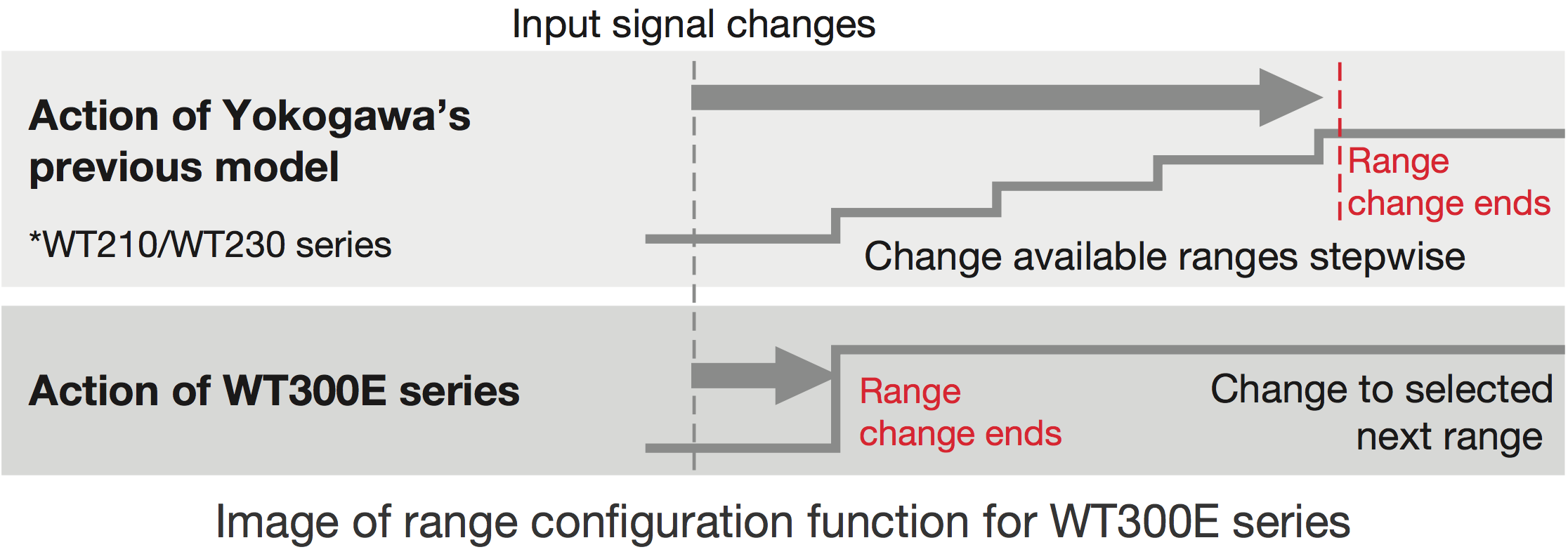
MAX hold, line filter and frequency filter. Peak capture on RMS/peak voltage and current, active, reactive and apparent power. Both filters cut off at 500 Hz for clean fundamental-waveform work.
Australian context worth knowing
The WT310E is a measurement category CAT II, 600 Vrms instrument. That is the correct and intended category for equipment powered through a fixed installation — a wall outlet fed from a distribution board — and for measurements made on that wiring. It is not rated for CAT III or CAT IV work: don’t take it to a switchboard, a distribution panel or a service entrance. For 230 V single-phase appliance and bench testing, CAT II is exactly right.
Order the –R power cord suffix for the AS standard plug so it arrives ready to plug into an Australian outlet. Supply is 100–240 VAC, 50/60 Hz, 50 VA maximum — no transformer, no adapter.
Yokogawa’s compliance documentation lists the EMC Regulatory Arrangement in Australia and New Zealand under its emissions standards (EN 55011 Class A, Group 1). Note the Class A designation: this is an industrial-environment instrument, and operation in a residential area may cause radio interference.
Why buy the WT310E from us
We’re a test and measurement specialist, not a general tool retailer. That means we can talk through the option codes with you before you order — because /G5 harmonics, /C7 Ethernet, /EX1 or /EX2 external sensor input and /DA4 analogue output are factory-fitted selections, and choosing wrong is an expensive lesson.
We support calibration and certification, we understand the compliance paperwork Australian trade and lab customers actually have to produce, and we’re here after the invoice clears. Talk to us about your application and we’ll help you spec the right configuration the first time.
TECHNICAL SPECIFICATIONS
| Specification | WT310E Value | Why It Matters |
|---|---|---|
| Input elements | 1 | Single-phase two-wire (1P2W) measurement — the right tool for appliance and product-level testing |
| Wiring system | 1P2W | Direct connection across a single load; no configuration ambiguity |
| Basic power accuracy (45–66 Hz) | ±(0.1% of reading + 0.05% of range) | Highest accuracy class in the compact power meter category; defensible for compliance reporting |
| Influence at power factor 0 | ±0.1% of apparent power (45–66 Hz) | Half the error of the previous generation — critical for standby loads where PF is near zero |
| Frequency bandwidth | DC, 0.1 Hz to 100 kHz (max 6 A above 30 kHz) | Handles DC, mains, inverter output and switching-frequency content in one instrument |
| Current ranges (CF 3) | 5 mA / 10 / 20 / 50 / 100 / 200 mA / 0.5 / 1 / 2 / 5 / 10 / 20 A | Twelve ranges spanning standby draw to full running load — one meter, one test |
| Current ranges (CF 6 / 6A) | 2.5 mA to 10 A | Doubles headroom for peaky, high-crest-factor waveforms |
| Voltage ranges (CF 3) | 15 / 30 / 60 / 150 / 300 / 600 V | 150 V and 300 V ranges suit 230 V Australian single-phase directly |
| Low-power resolution | Approx. 100 µW maximum resolution on 5 mA range | Resolves sub-watt standby consumption that general-purpose meters miss |
| Sampling rate | Approx. 100 kS/s, 16-bit simultaneous V and I conversion | Voltage and current sampled together — no phase error introduced by multiplexing |
| Data update rate | 100 ms / 250 ms / 500 ms / 1 / 2 / 5 / 10 / 20 s, or Auto | Fast enough for production tact time; Auto tracks fluctuating inputs to 0.1 Hz |
| Display | 7-segment LED, 4 simultaneous items, 4 or 5 digits | Four parameters visible at once without menu diving |
| Integration | Up to 10,000 hours; ±Wh, ±Ah, average active power | Year-long energy runs with auto ranging inside integration mode |
| Harmonics (/G5 option) | Up to 50th order, PLL 10 Hz–1.2 kHz, THD with settable max order | Adds harmonic and THD analysis without changing measurement mode |
| Communication (standard) | USB 2.0 (USBTMC-USB488) | Plug-and-play PC connection with free WTViewerFreePlus software |
| Communication (order code) | GP-IB (–C1) or RS-232 (–C2) | Choose to match existing ATE infrastructure |
| Communication (option) | Ethernet /C7 — 10/100BASE-TX, VXI-11, Modbus/TCP, DHCP | Direct data hand-off to recorders, PLCs and logging software |
| D/A output (/DA4 option) | 4 channels, ±5 V FS, 16-bit | Analogue recording of measured parameters to a data logger |
| External sensor input | /EX1: 2.5/5/10 V or /EX2: 50 mV–2 V | Extends the meter to clamp and current-sensor measurements above 20 A |
| Measurement category | CAT II, 600 Vrms | Correct for fixed-installation supplied equipment; not for switchboard work |
| Safety standards | EN 61010-1, EN 61010-2-030 | Recognised international safety design basis |
| Supply | 100–240 VAC (90–264 V permitted), 48–63 Hz, 50 VA max | Runs on Australian 230 V/50 Hz directly; order –R for AS plug |
| Dimensions / weight | Approx. 213 (W) × 88 (H) × 379 (D) mm / approx. 3 kg | Half-rack footprint; rack kits available (751533/751534-E2 or -J2) |
| Operating environment | 5–40 °C, 20–80% RH non-condensing, ≤2000 m | Suited to indoor labs and production floors |
| Warm-up time | Approx. 30 minutes | Allow warm-up before taking accuracy-critical readings |
| Included software | WTViewerFreePlus; PCM software (free download) | Setup, capture, trending and IEC 62301 standby testing at no extra cost |
What is the Yokogawa WT310E used for? The Yokogawa WT310E is a single-phase digital power meter used to measure the power consumption of electrical products — most commonly for standby power testing, ENERGY STAR® and IEC 62301 compliance work, appliance development, battery charger evaluation and production-line QA. It measures single-phase two-wire circuits with a basic power accuracy of ±0.1% of reading + 0.05% of range at 50/60 Hz.
How low can the WT310E measure current? The WT310E’s lowest current range is 5 mA (crest factor 3), with an effective input range starting at 1% of range — which puts practical measurement down into the tens of microamps. On that 5 mA range the meter offers a maximum power resolution of approximately 100 µW, which is what makes sub-watt standby measurement reliable rather than approximate.
What is the difference between the WT310E and the WT310EH? Both are single-element power meters. The WT310E covers twelve current ranges from 5 mA to 20 A with DC and 0.1 Hz to 100 kHz bandwidth, making it the low-current specialist. The WT310EH is the high-current variant: six ranges from 1 A to 40 A, direct 40 A RMS input without external sensors, and a narrower DC to 20 kHz bandwidth. Choose the WT310E for standby and product testing; choose the WT310EH for induction heaters and high-current equipment.
Can the WT310E measure three-phase power? No. The WT310E has one input element and measures single-phase two-wire circuits only. For three-phase three-wire or single-phase three-wire measurement, use the two-element WT332E. For three-phase four-wire (the 400/415 V configuration common in Australian distribution), use the three-element WT333E.
Does the WT310E measure harmonics? Only with the /G5 harmonics option fitted. The /G5 option adds PLL-synchronised harmonic analysis up to the 50th order over a fundamental frequency range of 10 Hz to 1.2 kHz, plus THD calculation with a user-settable maximum order. The option is factory-fitted at time of order, so it must be specified when purchasing.
Is the WT310E suitable for switchboard testing? No. The WT310E is a measurement category CAT II, 600 Vrms instrument, intended for equipment powered through a fixed installation such as a wall outlet, and for measurements on that wiring. Yokogawa explicitly states it should not be used for CAT III or CAT IV measurements, which covers distribution boards, circuit breakers and service entrance work.
What software comes with the WT310E? WTViewerFreePlus is included at no charge and handles instrument setup, numeric capture, harmonic values, trend graphs and data saving to a PC via USB, GP-IB/RS-232 or Ethernet — up to 200 parameters, and up to four connected WT300E series units of the same model code. Yokogawa’s separate Power Consumption Measurement (PCM) software, also free, runs IEC 62301 Ed. 1.0 and 2.0 standby power test procedures.






Reviews
There are no reviews yet.