
 Promotions


The Problem with Medium Voltage Cable Testing in the Field
Medium voltage cable infrastructure is the backbone of industrial facilities, utility networks, and renewable energy installations across Australia. When insulation degrades, faults develop, or commissioning sign-off is required, the testing process traditionally demands specialised, heavy equipment — and often more than one instrument. A withstand tester here, a tan delta analyser there, a separate sheath tester somewhere else. The logistics are slow, the cost is high, and coordinating multiple sets of gear on a live site creates unnecessary risk.
For electrical engineers, asset managers, and high-voltage test technicians who need fast, defensible results in the field, the status quo simply doesn’t cut it.
One System. Every Test You Need.
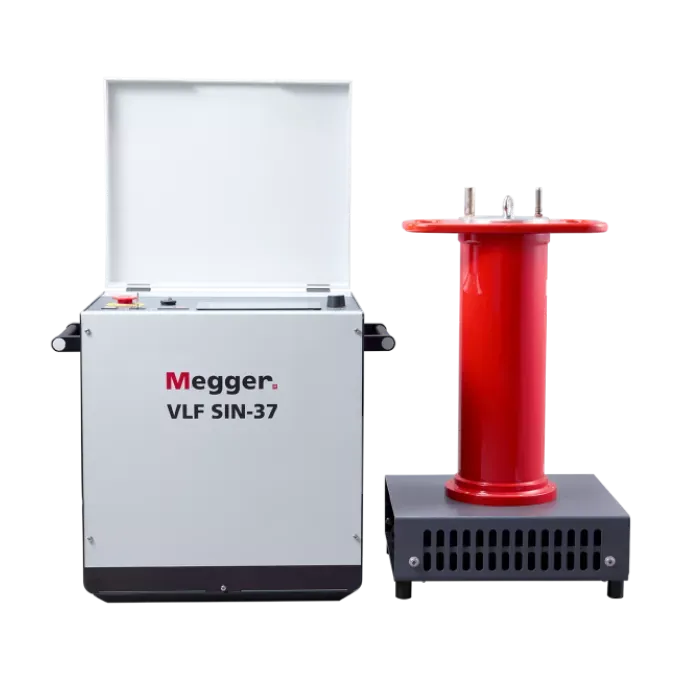
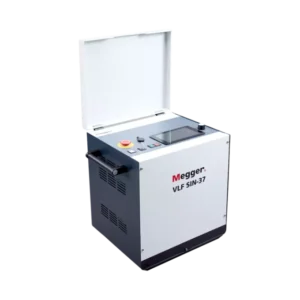
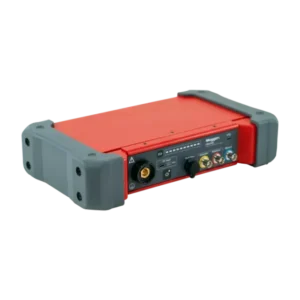
The Megger VLF Sine 37 kV changes the equation. Designed as a true all-in-one medium voltage cable diagnostic platform, it consolidates what traditionally required multiple instruments into a single portable unit small enough to transport in one piece. This isn’t a compromise — it’s the most powerful portable VLF tester in its class, capable of testing cables with capacitances up to 1.6 µF at 26 kVRMS and 0.1 Hz, which means cables exceeding 5 km present no challenge.
At just 29 kg, it delivers the highest test capacity in its class without the bulk of traditional HV test sets. It’s genuinely one-person portable, yet there’s no trade-off on power when testing long or heavily loaded cable circuits.
The system covers four core test disciplines out of the box:
- VLF withstand testing — using true sine wave voltage to stress cable insulation under controlled conditions
- DC testing — for applications where DC voltage is the required test method
- Sheath testing and fault pinpointing — up to -20 kV DC, fully compliant with IEC 60229, identifying sheath damage before it becomes a failure
- Internal tan delta diagnostics — available as an option, providing quantitative insulation condition assessment with automatic evaluation against IEEE 400.2 trending criteria
With the optional PDS 62-SIN partial discharge coupler, the system expands further into full PD diagnostics — making it a complete medium voltage cable test and diagnostic platform from a single, manageable package.
Smart Technology That Adapts to the Job
One of the most practical engineering decisions built into the VLF Sine 37 kV is its automatic frequency adjustment. As cable capacitance increases with cable length, maintaining a stable test voltage becomes more demanding. The system intelligently adjusts its test frequency — ranging from 0.01 Hz to 0.1 Hz — based on the connected cable’s capacitive load. On 15 kV-rated cables stretching to 25 km, the unit continues to deliver reliable, repeatable results without manual reconfiguration.
The output voltage is precisely controlled to ±1% accuracy across the full range (0–26 kVRMS in VLF sine mode, ±0–37 kV in DC mode), with 0.1 kV resolution. Source output current reaches 37 mA at 37 kVpeak, with measurement resolution down to 1 µA — the kind of precision that matters when you’re making asset management decisions based on leakage current trends.
Insulation resistance measurement extends up to 5 GΩ, covering the full range from healthy cable to severely degraded insulation.
For teams that need more than a pass/fail result, the optional internal tan delta module adds integrated insulation condition assessment to every VLF test — no second instrument, no second mobilisation. Quantitative dielectric loss measurements are evaluated automatically against IEEE 400.2 criteria, giving you a clear picture of cable health alongside the withstand result.
Built for the Field — No PC Required
High-voltage cable testing often happens in locations with no IT infrastructure, no comfortable desk, and no time for complicated software setups. The VLF Sine 37 kV addresses this directly. All test functions, data evaluation, and reporting are handled internally — the unit operates completely standalone without any external computer.
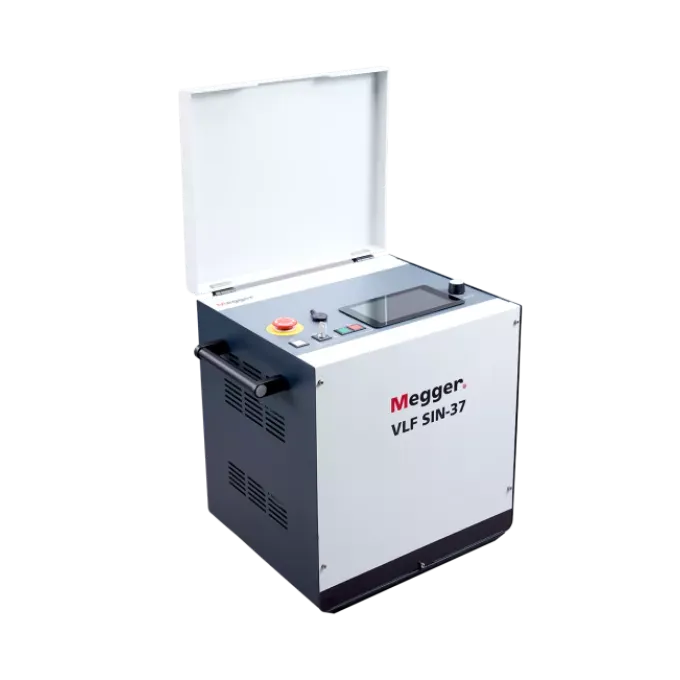
The 7-inch colour touchscreen interface is the heart of the user experience. Designed to minimise training time even for advanced diagnostic methods, it presents test parameters, live measurements, and evaluated results in a clear, logical workflow. Automatic result evaluation against IEEE 400.2 criteria means the unit interprets tan delta trends for you, flagging deterioration against both standard thresholds and user-defined trending limits.
Internal memory stores at least 1,000 measurements — a full season of fieldwork on a single unit. Results export via USB or LAN, with wireless connectivity on the roadmap. Crucially, historical measurements can be reviewed directly on the unit, allowing technicians to compare tests conducted months or years apart without needing to return to the office.
Safety Engineered In
Working with voltages up to 37 kV demands a test system with safety as a design priority, not an afterthought. The VLF Sine 37 kV includes automatic breakdown detection and automatic discharge of the test object after testing — removing the manual step that creates risk in the field. The system accepts a wide input voltage range (100–264 V, 50/60 Hz), making it compatible with Australian 230 V single-phase supplies as well as international site power.
The unit is rated IP21, operates across -20°C to +55°C, and stores safely between -20°C and +70°C — suitable for Australian conditions from alpine substations to outback solar farms.
HV test leads are available in 5, 10, or 15 m lengths, accommodating different site layouts, cable termination heights, and safe working distance requirements.
Expandable to a Full Diagnostic Platform
The modular architecture of the VLF Sine 37 kV means it grows with your testing requirements. The optional PDS 62-SIN PD coupler — the lightest partial discharge coupler available — attaches directly and transforms the system into a full withstand, tan delta, and PD diagnostic platform. When the job calls for pinpointing insulation weak spots rather than just assessing overall condition, this single add-on enables localisation of defects such as voids and water treeing without swapping instruments or reconfiguring your test setup. For sheath fault location, the system works in combination with the ESG NT2 step voltage probe using the 50 Hz voltage gradient method.
Additional accessories extend the system further: the HVCC leakage current correction module improves accuracy in challenging test environments, SF6 test adapters accommodate GIS-connected cable terminations, and optional external safety interlock units are available with or without remote operating controls.
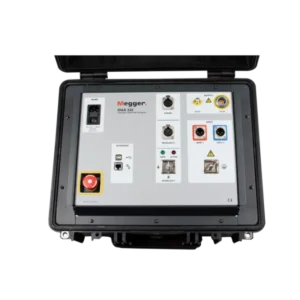
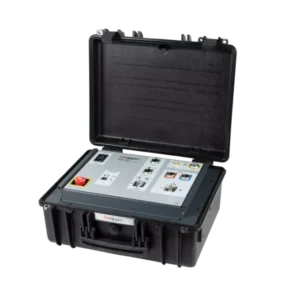
Optional transport cases (including an IP67-rated variant) provide rugged protection during transit to and from site.
TECHNICAL SPECIFICATIONS
| Parameter | Specification | Why It Matters |
|---|---|---|
| VLF Sine Wave Output | 0–26 kVRMS / 0–37 kVpeak | Covers all standard medium voltage cable ratings including 11 kV, 22 kV, and 33 kV systems common in Australian networks |
| DC Output Voltage | ±0–37 kV | Enables DC withstand testing where required by test standards or customer specifications |
| VLF Rectangular Voltage | 0–37 kV | Additional test mode for specific cable types |
| Voltage Accuracy | ±1% | Precision test voltage ensures results are reliable and repeatable across multiple test campaigns |
| Voltage Resolution | 0.1 kV | Fine control for setting test levels precisely to cable rating |
| Source Output Current | 37 mA @ 37 kVpeak | Sustains test voltage on high-capacitance cables — critical for long HV circuits |
| Current Accuracy | ±1% | High-accuracy leakage current measurement supports tan delta trending and condition assessment |
| Current Resolution | 1 µA | Detects subtle changes in insulation quality before they become failures |
| Frequency Range | 0.01–0.1 Hz (auto-adjusting) | Automatic frequency selection based on cable load enables reliable testing on cables up to 25 km |
| Output Load (primary) | 1.6 µF @ 0.1 Hz at 26 kVRMS | Handles the most demanding long-cable applications without external boosters |
| Output Load (extended) | 2.3 µF @ 0.1 Hz at 18 kVRMS | Extends testing flexibility on lower voltage cables with very high capacitance |
| Maximum Test Capacity | 10 µF | Maximum possible cable capacitance the unit can energise |
| Resistance Range | 0.1 MΩ–5 GΩ | Measures insulation resistance across the full spectrum from degraded to new cable insulation |
| Tan Delta — Measuring Frequency | 0.01–0.1 Hz | Matches VLF test frequency for simultaneous withstand and diagnostic testing |
| Tan Delta — Measuring Range | 10⁻⁴ to 100 | Covers cables from excellent condition to severely deteriorated insulation |
| Tan Delta — Accuracy | 10⁻⁴ | Meets the precision requirements of IEEE 400.2 trending assessment |
| Tan Delta — Resolution | 10⁻⁵ or 10⁻⁶ | Detects very early-stage insulation changes invisible to simpler test methods |
| Sheath Test Voltage | 0–-20 kV DC | Sufficient to test cable jacket integrity per IEC 60229 requirements |
| Sheath Fault Pinpointing | 0–-20 kV DC, pulse rates 0.5:1 / 1:2 / 1:3 / 1:4 / 1.5:0.5 | Variable pulse rates allow optimisation with the ESG NT2 step voltage probe for precise fault location |
| Safety | Automatic breakdown detection + auto discharge | Eliminates manual discharge steps, reducing risk for field operators |
| Input Power | 100–264 V, 50/60 Hz, 1500 VA | Compatible with Australian 230 V supply; accepts international site power |
| Duty Cycle | Continuous | Supports extended testing campaigns without thermal derating |
| Display | 7-inch colour touchscreen | Clear, intuitive interface reduces training time and operator error in field conditions |
| Connectivity | USB, LAN, wireless (coming soon) | Multiple export paths for test reports and data management |
| Internal Memory | ≥1,000 measurements | Stores a full testing campaign without need for external data management |
| Dimensions (W×H×D) | 529 × 478 × 380 mm | Compact enough for single-person transport and vehicle storage |
| Weight | 29 kg | Portable by one or two persons — no forklift or crane required |
| Protection Class | IP21 | Suitable for outdoor and substation environments |
| Operating Temperature | -20°C to +55°C | Reliable in all Australian climate zones, from alpine infrastructure to tropical and arid sites |
| Storage Temperature | -20°C to +70°C | Safe to store in vehicles or site containers without climate control |
APPLICATION USE CASES
1. Commissioning New Medium Voltage Cable Circuits
Before energising a new 11 kV or 22 kV cable circuit, network operators and electrical contractors need documented proof of insulation integrity. The VLF Sine 37 kV performs a witnessed withstand test to the required voltage level, then generates an evaluated result stored internally for inclusion in the commissioning package. The single-unit approach eliminates the need to mobilise multiple instruments, reducing both cost and site coordination effort.
2. Condition Assessment of Aged XLPE and PILC Cable
Underground distribution cables don’t fail without warning — insulation deterioration follows a predictable path that tan delta measurement can detect. Using the optional internal tan delta module, maintenance engineers can trend dielectric loss factor over multiple test campaigns and compare results against IEEE 400.2 evaluation criteria. Early identification of deteriorating cable segments allows planned replacement rather than emergency restoration after an unplanned outage.
3. Post-Fault Recommissioning After Cable Repair
Following a cable fault and repair, network owners require re-testing before the circuit is returned to service. The VLF Sine 37 kV applies the required withstand voltage, monitors for breakdown, and delivers a pass/fail result with full data logging — providing the documentation needed for both internal records and regulator compliance.
4. Sheath Integrity Testing on Screened Cables
Damage to the outer sheath of screened medium voltage cables allows moisture ingress, which accelerates insulation ageing and ultimately causes failure. With built-in sheath testing capability to -20 kV DC, the VLF Sine 37 kV identifies compromised sheath integrity across the cable run. When combined with the ESG NT2 step voltage probe, the system pinpoints the exact fault location, dramatically reducing excavation scope and repair costs.
5. Routine Maintenance Testing for Industrial MV Networks
Manufacturing facilities, mining operations, and large commercial sites operating their own medium voltage networks need periodic cable testing to satisfy insurance requirements and internal maintenance standards. A portable, standalone system that requires no external computer or specialist IT support simplifies the process — one technician, one instrument, results on screen.
6. Solar Farm and Wind Energy Cable Infrastructure
Large-scale renewable energy installations in Australia rely on extensive medium voltage cable networks connecting inverters, transformers, and grid connection points. During construction, commissioning, and periodic O&M testing, the VLF Sine 37 kV provides the withstand and diagnostic capability needed across long cable runs in remote locations where generator power or limited 230 V supply may be the only available source.
7. Partial Discharge Diagnostics with PDS 62-SIN
When tan delta results indicate deterioration or a cable’s history warrants deeper investigation, connecting the optional PDS 62-SIN PD coupler upgrades the VLF Sine 37 kV to a full partial discharge diagnostic system. PD testing localises defects such as voids, contamination, and water treeing within the insulation — providing the actionable data needed to decide between continued service, accelerated monitoring, or cable replacement.
What is the Megger VLF Sine 37 kV used for?
The Megger VLF Sine 37 kV is a portable medium voltage cable test and diagnostics system. It performs four functions in a single unit: VLF withstand testing (sine wave and rectangular), DC withstand testing, cable sheath testing with fault pinpointing, and tan delta (dielectric loss) diagnostics. With the optional PDS 62-SIN coupler, it also performs partial discharge diagnostics. It is used by electrical engineers, high-voltage test technicians, and asset managers to commission new cables, assess aged insulation, and locate faults on cables rated up to 33 kV.
How heavy is the Megger VLF Sine 37 kV?
The Megger VLF Sine 37 kV weighs 29 kg (64 lbs) and measures 529 × 478 × 380 mm. It is described as the smallest and lightest unit in its class, making it portable for field deployment without lifting equipment. Optional wheeled or IP67-rated transport cases are available for vehicle transport and site-to-site movement.
What is the maximum cable length the VLF Sine 37 kV can test?
The VLF Sine 37 kV can reliably test 15 kV-rated cables up to 25 km in length. Its automatic frequency adjustment system varies the test frequency between 0.01 Hz and 0.1 Hz based on the connected cable’s capacitance, ensuring consistent performance across both short and very long cable runs without manual reconfiguration.
Does the Megger VLF Sine 37 kV evaluate results automatically?
Yes. The VLF Sine 37 kV automatically evaluates test results according to the IEEE 400.2 standard when the internal tan delta option is fitted. It classifies cable insulation condition based on measured tan delta values against standard thresholds and supports user-defined trending limits for customised condition monitoring programs. All results are stored internally and can be reviewed directly on the 7-inch colour touchscreen without a connected computer.
What standards does the Megger VLF Sine 37 kV comply with?
The Megger VLF Sine 37 kV supports testing and evaluation in accordance with IEEE 400.2 (VLF testing and tan delta evaluation of shielded power cables) and IEC 60229 (sheath testing). These are the primary international standards governing VLF cable withstand testing and diagnostics. Megger Germany holds ISO 9001 quality management certification, and an optional test/calibration certificate is available for the instrument.









Reviews
There are no reviews yet.