
 Promotions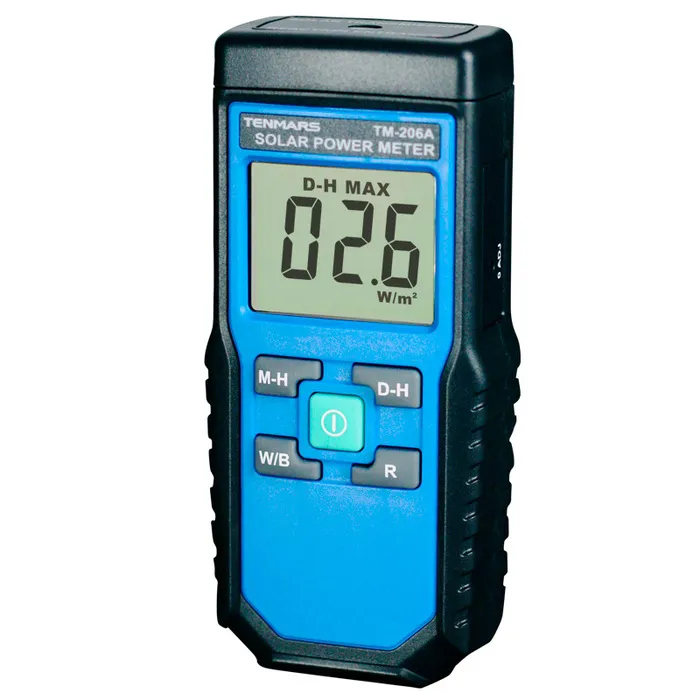



When Gut Feel Isn’t Good Enough
Every solar installer knows the frustration: panels installed at what looks like the right angle, but the system output doesn’t match expectations. Or a client asking for data to validate their window film investment, and all you can offer is an educated estimate. In solar energy, building performance, and environmental monitoring, the difference between a confident professional recommendation and a costly mistake often comes down to one thing — measured data.
Without a calibrated solar power meter, you’re relying on weather bureau averages, manufacturer STC ratings, or rough rule-of-thumb calculations. None of those tell you what’s actually happening at your specific site, at your specific time of day, on your specific installation angle. And that gap between assumed and actual irradiance is where both commissioning errors and missed optimisation opportunities live.
The Tenmars TM-206A Solar Power Meter is built to close that gap.
A No-Fuss Solar Irradiance Meter That Actually Fits in Your Kit Bag
The TM-206A is a dedicated solar irradiance meter — not a multimeter with a solar add-on, not a data logger trying to do too much. It does one thing exceptionally well: measure solar radiation quickly, accurately, and with a reading you can act on immediately.
Powered by a standard 9V battery and weighing just 300 grams, it’s genuinely portable. The 3½ digit LCD display gives a clean, unambiguous reading at a glance — no menu diving, no screen calibration, no configuration needed on site. You switch it on, point the sensor at the light source, and read the number. The 0.25-second sampling rate means the display updates fast enough to be useful when you’re adjusting panel angles in real time.
The unit measures from 0 to 1999 W/m² (or 0 to 634 BTU/(ft²·h)), covering the full range of practical solar irradiance conditions encountered in Australia — from overcast winter days in Melbourne to peak summer irradiance in Queensland or the Northern Territory. When the input exceeds the measurement range, the display shows “OL” (overload), so you always know you’re operating within valid measurement bounds.
Units toggle between W/m² (the standard SI unit used in solar energy, engineering, and scientific documentation) and BTU/(ft²·h) (used in some legacy HVAC and building science contexts), giving you flexibility depending on what your client’s documentation requires.
What Sets the TM-206A Apart: Accuracy That Earns Its Place on Site
Accuracy for a solar meter isn’t just about the sensor — it’s about knowing where the error comes from and how to account for it. The TM-206A’s silicon photodiode sensor responds across the visible light spectrum, making it suitable for measuring all visible-band solar radiation.
The accuracy specification is typically within ±10 W/m² or ±5% (whichever is greater), and the unit accounts for temperature-induced error at ±0.38 W/m²/°C from 25°C — a useful figure for professionals who need to factor in ambient conditions when interpreting site readings. The resolution is 1 W/m², which is precise enough for both comparative measurements (comparing irradiance at different panel tilt angles) and absolute assessments (determining whether a site receives adequate solar resource for a proposed system).
This level of accuracy is well-suited to field screening, comparative studies, and feasibility work. For laboratory-grade pyranometer accuracy, more expensive instrumentation is needed — but for the vast majority of solar installation, building inspection, and window film verification tasks in Australia, the TM-206A delivers what’s required at a price point that makes it a no-brainer addition to any field kit.
KEY FEATURES & PRACTICAL BENEFITS
| Feature | Practical Benefit |
|---|---|
| Dual display units: W/m² and BTU/(ft²·h) | Matches the documentation standard required by your client or project spec |
| 0.25-second sampling rate | Fast enough for real-time angle optimisation on rooftop installations |
| 1999 W/m² measurement range | Covers all realistic Australian solar irradiance conditions |
| 1 W/m² resolution | Useful for comparative site assessments and tilt-angle optimisation |
| OL (overload) indicator | Know immediately when you’re outside measurement range |
| 3½ digit LCD display | Clean, no-ambiguity readout in direct sunlight |
| 300g / compact 140 × 65 × 37.5 mm body | Fits in a tool bag, a vest pocket, or a laptop bag |
| 9V battery powered | No charging cables required — swap the battery and keep working |
| Silicon photodiode sensor (visible light spectrum) | Broadband response across all practical natural light conditions |
| Includes carrying case | Protected transport between sites without needing additional packaging |
TECHNICAL SPECIFICATIONS
| Specification | Value | Why It Matters |
|---|---|---|
| Measurement Units | W/m² or BTU/(ft²·h) | Dual-unit flexibility for different documentation and project standards |
| Measurement Range | 0–1999 W/m² / 0–634 BTU/(ft²·h) | Covers full spectrum from overcast to peak-sun Australian conditions |
| Resolution | 1 W/m² / 1 BTU/(ft²·h) | Fine enough for comparative tilt-angle assessments |
| Accuracy | ±10 W/m² or ±5% (whichever is greater) | Reliable field measurement for commissioning and feasibility work |
| Temperature Coefficient | ±0.38 W/m²/°C from 25°C | Helps interpret readings taken in high ambient temperature conditions |
| Overload Indication | “OL” display | Prevents misreading when irradiance exceeds measurement range |
| Display | 3½ digit LCD, max reading 1999 | Clear, unambiguous readout in field conditions |
| Sampling Time | 0.25 seconds | Near-instant response for dynamic measurements |
| Sensor Type | Silicon photodiode | Responds to full visible light spectrum |
| Power Supply | 9V battery (included) | Standard battery; easy field replacement |
| Dimensions | 140 × 65 × 37.5 mm | Compact and pocket-sized |
| Weight | Approx. 300g | Lightweight enough for all-day field carrying |
| Included Accessories | User manual, 9V battery, carrying case | Ready to use straight out of the box |
APPLICATIONS & USE CASES
Solar PV Installation & Commissioning
When you’re positioning panels on a residential or commercial rooftop, the TM-206A lets you measure irradiance at different tilt angles and orientations in real time. Rather than relying on sun-path software alone, you can physically confirm the optimal incident angle on the day of installation — particularly useful in urban environments where shading from nearby structures may differ from modelled predictions.
Solar Film & Window Tinting Verification
Window film and solar control glazing are valued based on how much solar energy they block. The TM-206A is purpose-built for this application: take a baseline irradiance reading on untreated glass, then a second reading through the film, and you have a transmission percentage your client can actually see. This is the kind of verifiable, professional-grade result that differentiates a quality window film installer from the competition.
Building Performance & NABERS Assessments
Facility managers and building performance consultants use solar irradiance data to evaluate glazing performance, assess passive solar heating and cooling loads, and support NABERS energy modelling. The TM-206A provides a quick, calibrated measurement that can be taken across multiple facade orientations without needing a full pyranometer station.
Solar Feasibility & Site Screening
Before committing to a full solar feasibility study with specialised equipment, site screeners can use the TM-206A to take preliminary irradiance readings across a proposed installation area. This helps identify shading issues, compare multiple potential locations, and provide clients with real data rather than bureau averages — all in a single site visit.
Educational & Research Applications
TAFEs, RTOs, and engineering departments teaching solar energy or environmental monitoring can rely on the TM-206A as a cost-effective, durable teaching instrument. Its straightforward operation makes it accessible to students while delivering genuine measurement data that can be compared against theoretical calculations.
HVAC & Building Envelope Analysis
HVAC engineers and energy auditors assessing solar heat gain through windows and skylights can use BTU/(ft²·h) output to directly reference older documentation or legacy system calculations, while staying accurate with current measured data.
Query: “What does a solar power meter measure?”
A solar power meter measures solar irradiance — the intensity of solar radiation falling on a surface, expressed in watts per square metre (W/m²) or BTU per square foot per hour (BTU/(ft²·h)). It is used to evaluate solar panel placement and tilt angles, assess window film transmission effectiveness, and quantify solar energy availability at a specific site. The Tenmars TM-206A Solar Power Meter measures from 0 to 1999 W/m² with a resolution of 1 W/m² and accuracy within ±10 W/m² or ±5%, whichever is greater.
Query: “How do I test solar panel efficiency on site?”
To test the solar irradiance at a solar panel installation site, point a solar power meter at the same angle as the intended panel orientation. The reading in W/m² represents the available solar energy at that angle and time of day. By comparing readings at different tilt angles, you can confirm the optimal incident angle before finalising installation. The Tenmars TM-206A Solar Power Meter is a practical tool for this type of field measurement, providing a 0.25-second sampling rate for real-time angle comparison.
Query: “Can I use a solar meter to test window film?”
Yes. A solar power meter can be used to measure the solar transmission of window films and solar control glazing. Take a baseline irradiance reading on untreated glass, then a second reading through the film in the same conditions. The percentage difference indicates how much solar radiation the film is blocking. The Tenmars TM-206A is specifically listed for this application and provides readings in both W/m² and BTU/(ft²·h) to match different documentation formats.




Reviews
There are no reviews yet.