
 Promotions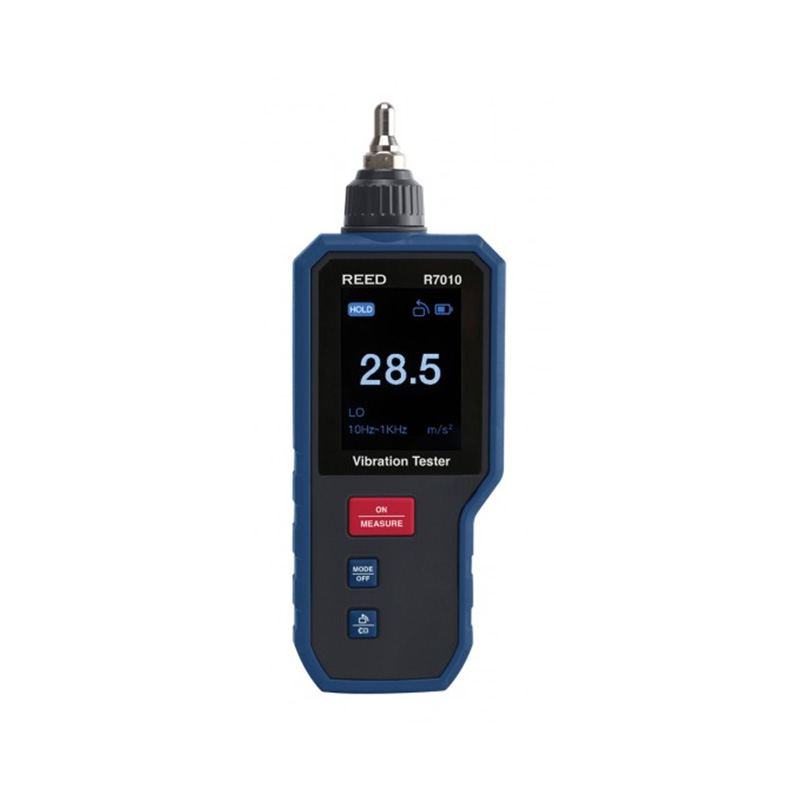


REED R7010 Vibration Meter – Tri-Mode Analysis for Predictive Maintenance & Rotating Equipment Diagnostics
The Hidden Cost of Unplanned Downtime
Every maintenance professional knows the scenario: a critical motor fails mid-shift, production grinds to a halt, and what should have been a planned bearing replacement becomes an emergency callout with premium parts pricing and overtime labour. According to industry estimates, unplanned downtime costs Australian manufacturers anywhere from $10,000 to $250,000 per hour depending on the operation. The frustrating reality? Most mechanical failures announce themselves weeks or months in advance through subtle changes in vibration patterns—if you have the right tool to detect them.
Vibration analysis sits at the heart of modern predictive maintenance programs, allowing technicians to identify developing faults in rotating machinery long before catastrophic failure occurs. Whether you’re monitoring HVAC plant room equipment, conveyor drives in a distribution centre, or pump stations in water treatment facilities, catching abnormal vibration signatures early transforms maintenance from a reactive cost centre into a strategic advantage.
Practical Vibration Analysis Without the Complexity
The REED R7010 delivers professional-grade vibration measurement in a format that suits the working realities of Australian maintenance teams. Rather than requiring specialist training or complex software interpretation, this meter presents acceleration, velocity, and displacement readings directly on a crisp 2.4-inch colour LCD—giving you actionable data in seconds rather than hours.
The tri-mode measurement capability addresses different diagnostic requirements within a single instrument. Acceleration measurements (ranging from 0.1 to 199.9 m/s²) excel at detecting high-frequency faults like bearing defects and gear mesh problems. Velocity readings (0.1 to 199.9 mm/s) provide the ISO-standard metric for overall machine condition assessment, making it straightforward to compare readings against established severity charts. Displacement measurements (0.001 to 1.999mm) reveal low-frequency issues including shaft misalignment, imbalance, and looseness in mounting arrangements.
The 360-degree rotating display solves a practical problem that anyone who has tried to read a meter while crouched under machinery will appreciate. Whether you’re reaching overhead to check a ceiling-mounted exhaust fan or measuring a floor-level pump, the screen orientation adjusts to provide comfortable viewing without awkward positioning.
Built for Workshop and Field Conditions
Interchangeable short and long probes adapt the R7010 to different access requirements. The short probe works well for direct contact on exposed bearing housings and motor casings, while the extended probe reaches measurement points in confined spaces or through guarding without requiring disassembly. Both probes thread directly into the meter body, eliminating cable tangles and connection reliability issues common with external sensor arrangements.
A built-in LED flashlight might seem like a minor feature, but it proves genuinely useful when identifying measurement points in poorly lit plant rooms, equipment enclosures, or during after-hours callouts. The rechargeable lithium-ion battery delivers approximately 12 hours of continuous operation—comfortably covering multiple shifts—with full recharge completing in around three hours via the included USB cable. Auto shut-off after five minutes of inactivity preserves charge when you’re moving between measurement locations.
From Data Points to Maintenance Decisions
The real value of vibration measurement lies not in the numbers themselves, but in how they inform maintenance planning. The R7010’s one-second response time allows efficient baseline surveys across multiple machines, building the comparative data that reveals deteriorating conditions over time. Trending velocity readings at monthly intervals, for instance, can highlight a bearing approaching end-of-life months before audible noise or excessive heat become apparent.
For operations implementing condition-based maintenance programs aligned with AS ISO 10816 machinery vibration standards, the velocity measurement range and accuracy specification (±5% reading plus 2 digits) support meaningful severity assessments. While this meter doesn’t store historical data internally, its straightforward operation encourages consistent measurement practices—the foundation of any effective predictive maintenance program.
The dual frequency range capability on acceleration measurements (10Hz to 1kHz low range, 1kHz to 15kHz high range) provides flexibility for different fault detection applications. Lower frequencies reveal imbalance and misalignment issues, while high-frequency measurements expose early-stage bearing defects before they progress to more serious damage.
Quality Assurance and Support
The REED R7010 carries CE and UKCA certification, confirming compliance with applicable European and UK safety and electromagnetic compatibility requirements. Australian customers benefit from local warranty support and access to replacement probes and accessories without international shipping delays.
Compact dimensions (180 × 64 × 28mm) and light weight (191g) make the R7010 a practical addition to maintenance tool kits without adding bulk. The included carrying case protects the meter and both probes during transport and storage, keeping everything organised and ready for the next inspection round.
TECHNICAL SPECIFICATIONS TABLE
| Parameter | Specification | Practical Application |
|---|---|---|
| Acceleration Range | 0.1 to 199.9 m/s² | Detects high-frequency bearing defects and gear mesh faults |
| Acceleration Accuracy | ±(5% rdg. + 2 digits) | Reliable trending for predictive maintenance programs |
| Acceleration Frequency | LO: 10Hz–1kHz / HI: 1kHz–15kHz | Switchable ranges for imbalance vs. bearing diagnostics |
| Velocity Range | 0.1 to 199.9 mm/s | ISO-standard metric for overall machine condition assessment |
| Velocity Accuracy | ±(5% rdg. + 2 digits) | Supports severity classification against AS ISO 10816 charts |
| Velocity Frequency | 10Hz to 1.5kHz | Covers typical rotating machinery fault frequencies |
| Displacement Range | 0.001 to 1.999mm | Identifies low-frequency misalignment and looseness |
| Displacement Accuracy | ±(10% rdg. + 2 digits) | Suitable for comparative trending and fault detection |
| Displacement Frequency | 10Hz to 1kHz | Optimised for shaft-related fault signatures |
| Display | 2.4″ TFT Colour LCD | Clear readings in varying light conditions |
| Screen Rotation | 360° adjustable | Comfortable viewing at any measurement angle |
| Response Time | 1 second | Efficient multi-point surveys |
| Battery | 1350mAh Li-ion rechargeable | Approximately 12 hours continuous operation |
| Charge Time | ~3 hours via USB | Overnight charging covers next-day requirements |
| Auto Shut-off | 5 minutes inactivity | Preserves battery during intermittent use |
| Operating Temperature | -10°C to +50°C | Suitable for refrigerated spaces through hot plant rooms |
| Storage Temperature | -20°C to +60°C | Tolerates vehicle storage in Australian conditions |
| Operating Humidity | 10% to 90% RH | Handles typical industrial environments |
| Dimensions | 180 × 64 × 28mm | Pocket-friendly for tool belt carry |
| Weight | 191g | Lightweight for overhead and extended measurements |
| Certifications | CE, UKCA, RoHS | International compliance verification |
INCLUDED IN THE BOX
- REED R7010 Vibration Meter
- Short Contact Probe
- Long Contact Probe
- USB Charging Cable
- Protective Carrying Case








Reviews
There are no reviews yet.