 Promotions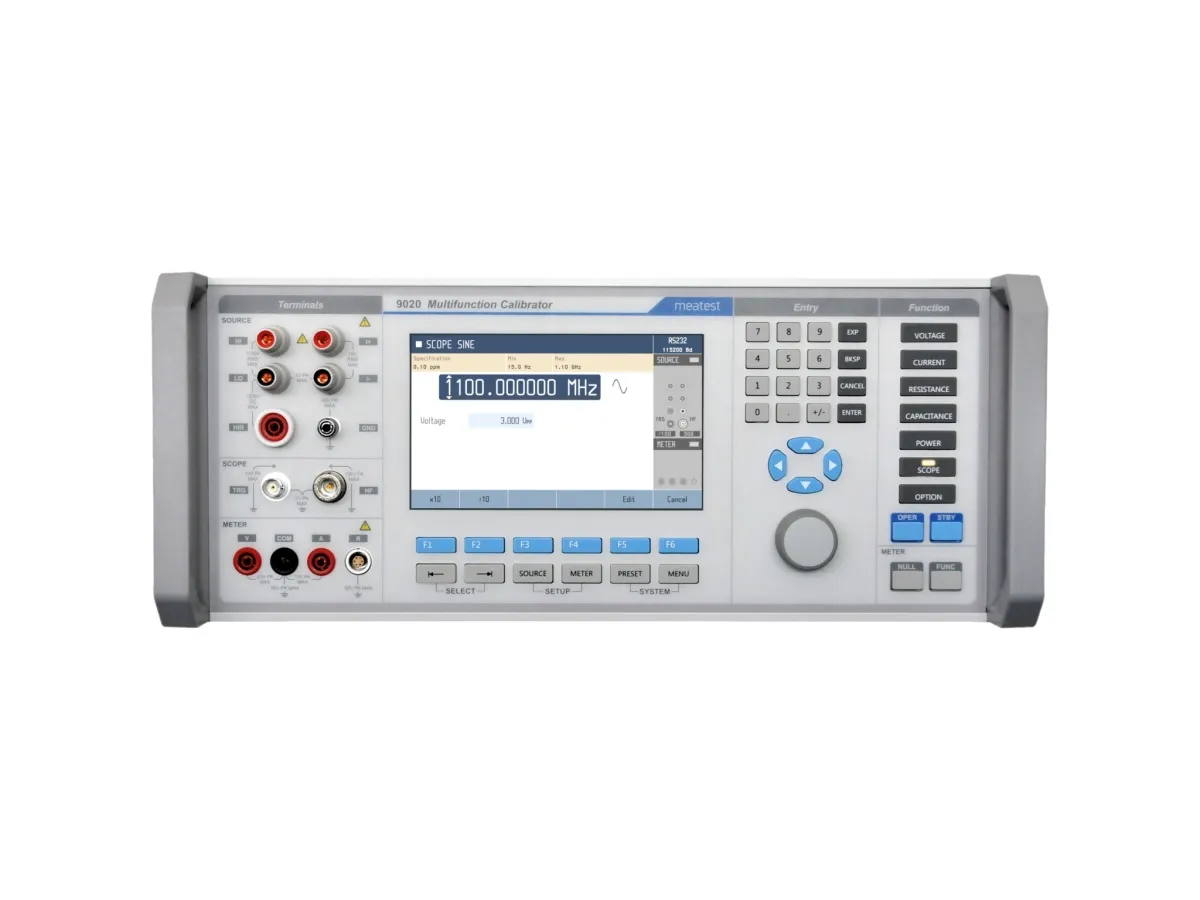


The Bottleneck Every Calibration Lab Knows
If your lab handles a mix of multimeters, clamp meters, power meters, and insulation testers, you’ve probably lived with the compromise: multiple reference sources, multiple setups, multiple opportunities for error.
Swapping between instruments mid-calibration wastes time, introduces connection uncertainty, and makes automated workflows unnecessarily complex. Add oscilloscope calibration to the mix and you’re looking at a second (or third) piece of kit occupying valuable bench space.
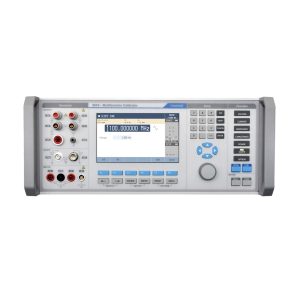
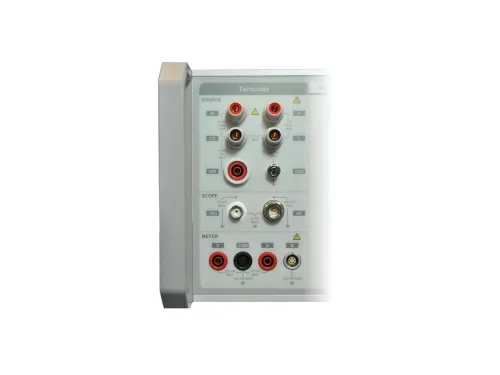
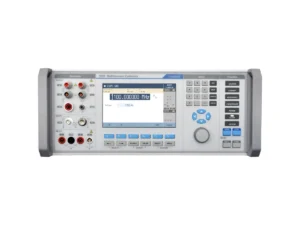
The Meatest 9020 Multifunction Calibrator is designed to eliminate that bottleneck. It consolidates the output functions your lab needs most — AC/DC voltage and current, resistance, capacitance, power, energy, temperature simulation, and frequency — into a single, rack-mountable reference instrument with a 9 ppm basic uncertainty.
For labs servicing everything from handheld DMMs to 6½-digit bench meters, it covers the full workload without the clutter.
One Instrument. Your Entire Electrical Calibration Workload.
The 9020 is built around a broad-coverage output architecture designed for the realities of a mixed-instrument calibration lab. Here’s what it sources:
AC/DC Voltage (0 mV – 1050 V) Covers both DC and AC sine from 1 mVRMS to 1050 VRMS, with non-sine waveforms (sawtooth, triangle, square, truncated sine) available up to 200 VRMS. DC basic uncertainty is as low as 8 ppm of value on the 20 V range — suitable as a reference for all but the most demanding 8½-digit DMM calibrations. AC uncertainty runs to 160 ppm across the primary range. Frequency accuracy is 5 ppm with 5-digit resolution across the 3 Hz – 300 kHz span.
AC/DC Current (0 µA – 30 A) The 9020 pushes current output to 30 A — making it well suited for calibrating high-range clamp meters used by industrial maintenance teams and energy monitoring specialists. With the optional 0950 Current Coil accessory, simulated current scales to 1500 A with a 45–65 Hz frequency range and 0.3 % additional uncertainty. DC current uncertainty is as low as 100 ppm on the mid-ranges, with AC uncertainty from 300 ppm at standard frequencies.
Resistance & Capacitance Variable resistance simulation from 0 Ω to 1.1 GΩ with 6½-digit resolution and uncertainty as tight as 15 ppm (1 kΩ–100 kΩ fixed standards). Capacitance sources from 600 pF to 120 mF with 0.15% uncertainty across the primary range. Both 4-wire (Kelvin) and 2-wire modes are supported, with dedicated 2W-COMP mode for compensated 2-wire measurements.
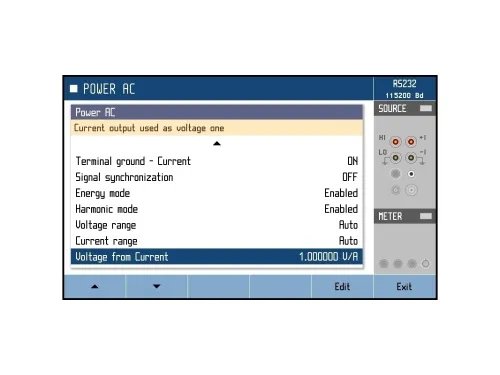
AC/DC Power & Energy (40 µW – 31.5 kW) Power calibration spans DC to 1000 Hz across voltage and current combinations from 0.2 V/0.2 mA up to 1050 V/30 A. Phase shift uncertainty is 0.15° to 200 Hz. Total power accuracy on a 230 V/50 Hz EU grid with a 1 A load is 0.069 % of value — highly competitive for calibrating energy meters and power analysers used in sub-metering, solar PV monitoring, and industrial energy management. Harmonic distortion capability covers 50 harmonic products (15–1000 Hz fundamental), making the 9020 directly applicable to testing power quality instruments against harmonic content requirements.
Temperature Simulation (RTD & Thermocouple) RTD simulation supports Pt385, Pt3916, Pt3926, Ni672, Cu427, Cu428, and custom curves with R0 range 20 Ω–2 kΩ. Uncertainty is 0.01–0.07 °C. Thermocouple support covers types A, B, C, D, E, G, J, K, L, M, N, R, S, T, U, and XK, with manual or automatic cold junction compensation via Adapter 91. TC uncertainty ranges 0.05–0.55 °C — adequate for calibrating all common industrial temperature instruments.
Frequency (0.1 Hz – 2 MHz) Square-wave frequency output at 100 mVpk, 1 Vpk, or 3 Vpk with 5 ppm accuracy and duty cycle control (0.1%–99.9%). Suitable for calibrating frequency-input process meters, panel instruments, and data loggers.
Built-In Process Multimeter
An optional internal measurement module (MER option) allows the 9020 to simultaneously source a stimulus signal and measure the device under test’s output — critical for calibrating transducers, loop-powered process transmitters, and industrial sensors. The built-in meter covers DC voltage (0–12 V), DC current (0–24 mA), resistance (0–20 kΩ), RTD and thermocouple temperature, and frequency (1 Hz–100 kHz).
This simultaneous source-and-measure capability simplifies transducer calibration workflows considerably and supports simulation of strain gauges and other bridge-type sensors via the 9000-60 cable accessory.
Oscilloscope Calibration Options
Two scope calibration options extend the 9020’s frequency output into the RF domain:
- SCO option: Levelled sine output to 400 MHz, pulse/time marker to 400 MHz, trigger output, and input impedance measurement (100 Ω / 2 MΩ). Amplitude uncertainty 0.5% + 350 µVpk at low frequency, extending to 3.7% at 400 MHz. Jitter < 2 ns, rise time < 1 ns.
- SC1 option: Extends levelled sine to 1.1 GHz (amplitude range 1.4 mVpk–1.5 Vpk to 1 GHz; 1.4 mVpk–1 Vpk above 1 GHz). Frequency uncertainty drops to 0.1 ppm in pulse/time marker mode.
These options make the 9020 one of the few compact multifunction calibrators capable of supporting both bench instrument calibration and oscilloscope bandwidth verification from a single chassis.
High Voltage Resistance for Insulation Tester Calibration
The HVR option adds a dedicated high-voltage resistance output specifically designed for verifying insulation resistance testers and megaohmmeters. Resistance range spans 100 kΩ to 100 GΩ with test voltages to 1500 VDC. This is directly relevant to Australian labs calibrating instruments used under AS/NZS 3000 compliance programs, electrical safety testing, and NATA-accredited electrical calibration services. Resistance uncertainty is 0.2–3% depending on range; test voltage uncertainty 0.3%–1.5% + 5 V.
Automation and Lab Integration
The 9020 ships with RS-232, IEEE-488 (GPIB), USB, and Ethernet interfaces as standard — making it straightforward to integrate with existing automated calibration platforms. For labs using Meatest’s own WinQbase or Caliber software, the 9020 supports the CamOCR optical readout module, which allows semi-automated calibration of instruments with no remote control interface — useful for legacy analogue meters and older DMMs. A full communication API is documented in the user manual for custom automation development.
Preset storage allows senior technicians to define verified output configurations that less experienced operators can recall and execute, reducing human error in high-throughput calibration environments.
Why It Suits Australian Calibration Labs
Australian labs operating under NATA accreditation requirements need calibration sources with traceable uncertainty chains that clearly support the instruments under test. The 9020’s 12-month stability specifications — stated at 95% confidence, k=2 — satisfy the rigorous uncertainty budgeting requirements of ISO/IEC 17025.
Its coverage of insulation resistance (to 1.5 kV), power (AC/DC to 1050 V/30 A), and temperature simulation means a single instrument can support calibration of the test equipment categories most commonly used by Australian electrical contractors, industrial maintenance teams, and compliance testers working to AS/NZS 3000, AS/NZS 3017, and related standards.
For calibration businesses and in-house labs looking to reduce instrument capital while maintaining accreditation-ready uncertainty performance, the 9020 represents a compelling consolidation investment.
USE CASES
1. NATA-Accredited Electrical Calibration Laboratories
The 9020’s 9 ppm DC voltage accuracy and comprehensive multi-function output make it a primary reference source for calibrating multimeters, clamp meters, and bench DMMs across the full workload of a general electrical calibration lab.
Its IEC 61010 safety compliance and traceable uncertainty specifications align directly with ISO/IEC 17025 accreditation requirements.
2. Power Analyser and Energy Meter Calibration
With AC/DC power output to 31.5 kW (1575 kW with optional 0950 Current Coil), phase shift uncertainty of 0.15° to 200 Hz, and 50-harmonic generation capability, the 9020 is well-suited to calibrating single and three-phase power analysers, revenue-grade energy meters, and power quality instruments used in industrial sub-metering and solar PV grid connection applications.
3. Industrial Transducer and Process Meter Calibration
The optional MER module enables simultaneous sourcing and measurement, supporting the calibration of loop-powered 4–20 mA transmitters, pressure and temperature transducers, and process meters. Combined with RTD and thermocouple simulation, this makes the 9020 valuable for industrial maintenance calibration teams in manufacturing, resources, and utilities sectors.
4. Oscilloscope Bandwidth Verification
With the SCO (400 MHz) or SC1 (1.1 GHz) option, the 9020 extends into oscilloscope calibration territory — delivering levelled sine signals, pulse/time markers, trigger outputs, and input impedance measurement from the same chassis that handles DC voltage reference work.
This suits calibration service providers who need oscilloscope capability without a dedicated RF calibrator.
5. Insulation Tester and Megohmeter Calibration
The HVR option provides test voltages to 1500 VDC with resistance simulation from 100 kΩ to 100 GΩ — directly addressing the calibration requirements for insulation resistance testers (Meggers) used across Australia’s electrical contracting, industrial, and infrastructure sectors, where compliance with AS/NZS 3000 and AS/NZS 3760 is mandatory.
6. Electrical Safety Test Equipment Calibration Services
Calibration service providers offering certificate-of-calibration services to electrical contractors, facilities managers, and industrial clients can use the 9020 to support PAT tester, loop tester, and installation tester calibration programmes. The instrument’s broad output coverage reduces the number of reference sources required and simplifies multi-function service delivery.
TECHNICAL SPECIFICATIONS
| Parameter | Specification | Why It Matters |
|---|---|---|
| Basic DC Voltage Uncertainty | 8–30 ppm (range dependent, 1-year, k=2) | Sets the minimum uncertainty budget for all DMM and voltmeter calibrations |
| DC Voltage Range | 0 mV – 1050 V | Covers full low-voltage span from signal-level to mains-equivalent |
| AC Voltage Range | 1 mVRMS – 1050 VRMS, 3 Hz – 300 kHz | Covers audio-frequency through RF-adjacent calibration requirements |
| DC Current Range | 0 µA – 30 A | Calibrates clamp meters and high-range ammeters directly |
| AC Current Range | 10 µARMS – 30 ARMS, 10 Hz – 30 kHz | Enables full AC clamp meter and current transducer calibration |
| Current Output (with 0950 Coil) | Up to 1500 A simulated | Required for large clamp meter calibration (e.g. 1000 A range) |
| Resistance Range | 0 Ω – 1.1 GΩ (variable); 0 Ω – 1 GΩ (fixed standards) | Full coverage for DMM, LCR meter, and ohmmeter calibration |
| Resistance Uncertainty (15 ppm) | 1 kΩ – 100 kΩ fixed standards | Supports 6½-digit DMM calibration at reference-grade accuracy |
| Capacitance Range | 600 pF – 120 mF | Calibrates capacitance meters and LCR instruments across practical ranges |
| Capacitance Uncertainty | 0.12–0.45% (range dependent) | Sufficient for all commercial and trade-grade capacitance meter calibration |
| Power Range | 40 µW – 31.5 kW (DC + AC 15–1000 Hz) | Covers sub-watt signal-level through high-power three-phase meter calibration |
| Power Accuracy (230 V/50 Hz, 1 A) | 0.069% of value | Meets revenue meter calibration requirements in Australian energy sector |
| Harmonic Distortion Output | 50 products, 15–1000 Hz fundamental | Validates power quality analyser harmonic measurement performance |
| Phase Shift Uncertainty | 0.15° (≤200 Hz), 0.25° (>200 Hz) | Directly affects power factor and reactive power calibration accuracy |
| Temperature (RTD) | Pt385, Pt3916, Pt3926, Ni672, Cu427, Cu428, custom | Covers all common industrial RTD standards |
| RTD Uncertainty | 0.01–0.07 °C | Laboratory-grade temperature simulation for calibrating RTD transmitters |
| Temperature (TC) | Types A, B, C, D, E, G, J, K, L, M, N, R, S, T, U, XK | Broadest thermocouple type coverage available in this class |
| TC Uncertainty | 0.05–0.55 °C | Adequate for all common industrial TC instrument calibration |
| Frequency Range | 0.1 Hz – 2 MHz | Calibrates frequency-input panel meters, counters, and data loggers |
| Frequency Accuracy | 5 ppm | Excellent for general-purpose frequency meter calibration |
| Scope Option (SCO) | Levelled sine to 400 MHz | Oscilloscope bandwidth calibration without a dedicated RF calibrator |
| Scope Option (SC1) | Levelled sine to 1.1 GHz | High-bandwidth oscilloscope calibration for service and metrology labs |
| Insulation Resistance (HVR Option) | 100 kΩ – 100 GΩ, up to 1500 VDC | Calibrates insulation testers and megaohmmeters used in electrical compliance |
| Interfaces | RS-232, IEEE-488 (GPIB), USB, Ethernet | Full automation compatibility; no additional interface cards required |
| Safety Compliance | IEC 61010 ed. 2 (Safety Class I), EN 61326 (ESD Class I), Overvoltage CAT II | Meets laboratory safety requirements |
| Operating Temperature | +13 °C – +33 °C | Standard lab environment; reference temperature 21–25 °C |
| Warm-Up Time | 30 minutes | Standard for instruments of this class; plan calibration schedules accordingly |
| Power Supply | 115/230 V, 50/60 Hz, 450 VA max | Compatible with Australian 230 V/50 Hz mains supply |
| Dimensions (W × H × D) | 434 × 191 × 641 mm | Standard 3U/4U rack-mountable bench footprint |
| Weight | 24–25 kg (options dependent) | Bench-use instrument; not designed for field transport |
AVAILABLE OPTIONS
| Option Code | Description | Best For |
|---|---|---|
| SCO | Oscilloscope calibration to 400 MHz; includes N/BNC adapter | Labs calibrating general-purpose oscilloscopes |
| SC1 | Oscilloscope calibration to 1.1 GHz; includes N/BNC adapter | Service labs with high-bandwidth scope calibration requirements |
| HVR | High voltage resistance to 1.5 kV; includes 191-11 5 kV cable | Labs calibrating insulation testers and megaohmmeters |
| MER | Process multimeter option; includes 9000-60 4W measurement cable | Transducer and process meter calibration, strain gauge simulation |
| 0950 Current Coil | Multiplication factors 10×, 25×, 50×; max 1500 A | Large clamp meter and high-current instrument calibration |
What is the Meatest 9020 used for? The Meatest 9020 is a bench-top multifunction calibrator used in electrical calibration laboratories to verify and calibrate a wide range of electrical test instruments. It sources AC and DC voltage (up to 1050 V), AC and DC current (up to 30 A), resistance, capacitance, power, energy, temperature (RTD and thermocouple), and frequency from a single instrument. Optional modules extend its capability to oscilloscope calibration (to 1.1 GHz) and insulation resistance tester calibration (to 1500 VDC). It is designed for labs calibrating multimeters, clamp meters, power analysers, energy meters, process meters, and transducers.
What is the accuracy of the Meatest 9020? The Meatest 9020 has a basic DC voltage uncertainty of 9 ppm (with the best range achieving 8 ppm of value over 12 months at k=2, 95% confidence). AC voltage uncertainty is from 160 ppm, DC current from 100 ppm, and AC power accuracy at 230 V/50 Hz is approximately 0.069–0.142% depending on current level. All specifications are all-inclusive: they cover 12-month stability, temperature effects, linearity, load regulation, and calibration traceability.
Can the Meatest 9020 calibrate insulation testers? Yes. With the HVR (High Voltage Resistance) option, the Meatest 9020 can calibrate insulation resistance testers and megaohmmeters. The HVR option provides resistance simulation from 100 kΩ to 100 GΩ at test voltages up to 1500 VDC, covering the full measurement range of insulation testers used in electrical safety compliance testing. A 5 kV-rated test cable (191-11) is included with the HVR option.