 Promotions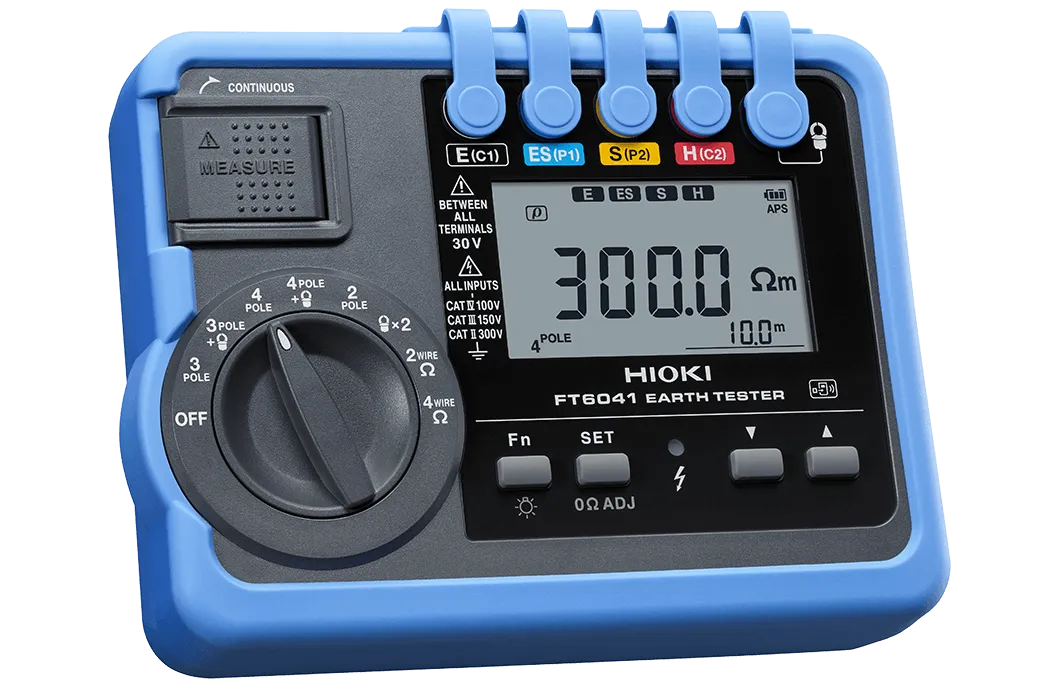
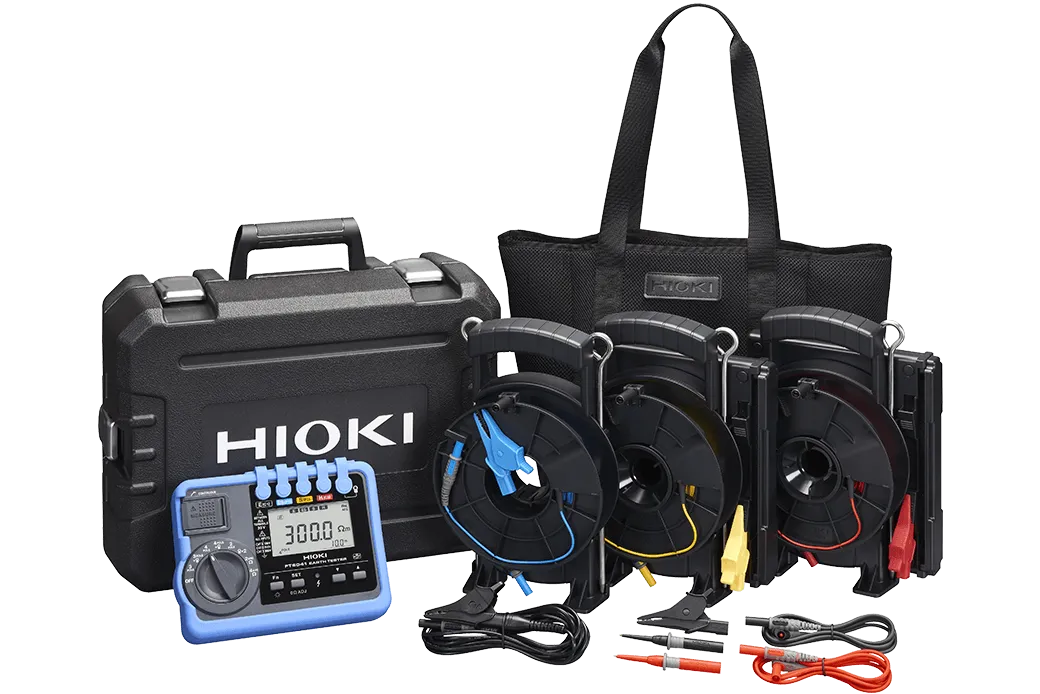
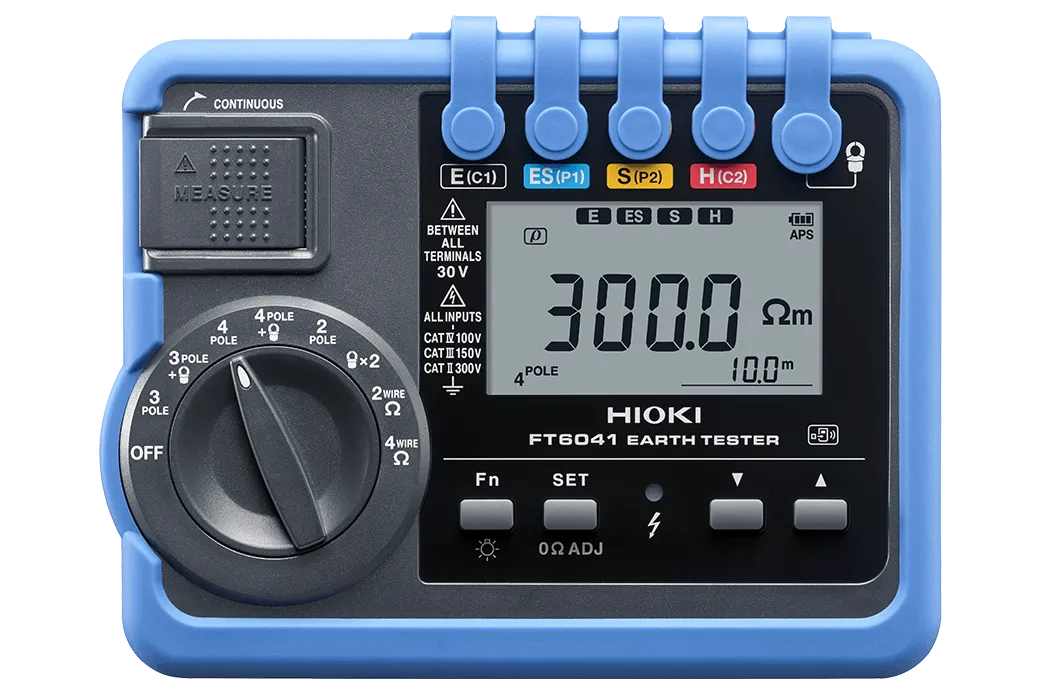
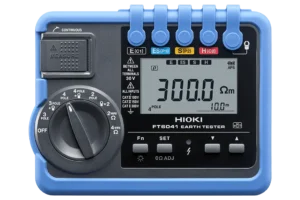



HIOKI FT6041 Earth Tester — Field-Ready Ground Resistance Testing for Any Site, Any Condition
The Problem With Most Earth Resistance Testing on Australian Sites
Ask any sparkie who’s spent time doing earthing compliance work what frustrates them most and you’ll hear the same answers: cords that tangle the moment you unwind them, dry soil that means you’re hammering auxiliary rods in again and again just to get a usable reading, and the awkward conversation with a site manager about shutting down power to a server room or hospital wing — just so you can run a standard 3-pole test.
Then there’s the paperwork. Carrying a notebook in the field, scribbling down values, trying to reconstruct a compliant test record later from memory and mud-smeared handwriting. It’s slow, error-prone, and honestly unnecessary with modern equipment.
Earthing system verification is a non-negotiable part of Australian electrical compliance work. Under AS/NZS 3000 (the Wiring Rules), electrical installations must have effective earthing to protect people from electric shock and equipment from fault damage. Soil resistivity surveys are required before grounding system design on commercial and industrial builds. Periodic testing of existing installations is required for ongoing compliance, particularly in facilities covered by AS/NZS 3017. The stakes are real — and your test instrument needs to be up to the job every single time.
The HIOKI FT6041 Earth Tester was engineered to address every one of these pain points directly.
Six Measurement Methods. One Instrument.
Most earth testers on the market do the basics — 3-pole testing, maybe a 2-pole continuity check. The FT6041 goes considerably further, covering the full range of measurement scenarios encountered in real Australian electrical work:
3-Pole Method — The standard fall-of-potential method for precisely measuring ground resistance. Delivers results in just 6 seconds, with accuracy of ±1.5% rdg. ±4 dgt. across the core measurement range. Suitable for general electrical installation testing and compliance verification.
4-Pole Method (Wenner’s Method) — Essential for soil resistivity measurement prior to grounding system design on new construction projects. Geological conditions vary dramatically across Australian regions — sandy coastal soils behave very differently to dense clay or rock formations inland. Getting this right upfront saves time, money, and compliance headaches later.
MEC (Measuring Earth with a Clamp) — HIOKI’s standout capability. The MEC function — Measuring Earth with a Clamp — augments the 3-pole method with a clamp sensor to measure only the current flowing through the specific electrode under test. The result: you can measure earth resistance on live systems without disconnecting a single wire and without shutting down power. For data centres, hospitals, manufacturing facilities, and any other site where power interruption isn’t an option, this is a genuine game-changer.
3-Pole Method with 4-Terminal Measurement — When you’re dealing with very low resistance ground systems — sub-ohm values on bonded structural steel or reinforced concrete installations — this method delivers the precision required.
2-Clamp Method — For multi-point earthing systems where multiple parallel grounds are installed, the 2-clamp method lets you test individual earth electrodes in a network without disconnecting them from the system.
Low-Resistance Measurement — A built-in continuity check function using 4-terminal or 2-terminal measurement, covering ranges from 0.00 Ω to 3000 Ω. Ideal for confirming continuity of bonding conductors immediately after completing ground resistance testing — keeping your workflow tight.
Built to Survive Australian Jobsites
Anyone who’s used an entry-level earth tester in the field knows the anxiety of a $400 instrument sitting in the dirt on a wet construction site or getting covered in red dust on a regional job. The FT6041 is built like it expects to be treated badly.
IP67 Rated for Dust and Water — Completely sealed against dust ingress and protected against immersion in water to 1 metre depth. Mud splatter, rain, puddles — wash it off with water when you’re done. The EN60529-certified IP67 rating covers both the main unit and its sealed connectors.
-25°C to +65°C Operating Range — Australian conditions are extreme in both directions. Whether you’re working through a Queensland summer on an exposed substation site or doing winter commissioning work in alpine Victoria, the FT6041 keeps operating without complaint across its full temperature range.
1-Metre Drop Resistance — With the protector fitted, the FT6041 withstands a 1-metre drop onto concrete. This isn’t a marketing claim — it’s tested to the standard. For an instrument regularly carried up ladders, across scaffolding, and in and out of site vehicles, this matters.
30 V RMS Ground Potential Tolerance — In environments where stray ground potentials are present — near power distribution infrastructure, industrial plant, or high-voltage installations — the FT6041 continues to deliver stable readings with an allowable ground potential of 30.0 V RMS. Live wire warning activates automatically when ground potential is detected.
Designed to Cut Time on Site
Every minute saved on a measurement job is money back in your pocket. The FT6041 has been purpose-designed to eliminate the time-wasters.
Cord Winding That Actually Works — The measurement cables (included 25m yellow, 25m blue, and 50m red cables) are fitted with winders that retract cleanly without tangling or twisting. This sounds like a small thing until you’ve spent 10 minutes straightening knotted cables in a muddy paddock.
100 kΩ Maximum Allowable Electrode Resistance — In dry or rocky Australian soils, getting good auxiliary electrode contact is a persistent challenge. The FT6041’s 100 kΩ maximum allowable resistance for auxiliary grounding electrodes means a single insertion is usually sufficient — no repeated pouring of water around the rods, no repeat insertions trying to hit a usable resistance value.
Earth Nets Module for Concrete Surfaces — Not every measurement location has accessible soil. The included L9846 Earth Nets Module provides a flat-surface electrode alternative for hard-standing concrete areas. Open the module, make contact with the surface, add a splash of water, and take the reading. No drilling required.
6-Second Measurement Time — Full 3-pole measurement in 6 seconds. Combined with auto-hold to capture the reading and continuous measurement mode for monitoring, the FT6041 keeps your workflow moving.
Wireless Data Capture and Reporting
The FT6041 supports the optional HIOKI Z3210 Wireless Adapter (available separately or as part of the FT6041-90 and FT6041-92 KIT variants), enabling Bluetooth connectivity to iOS and Android devices.
Paired with the free GENNECT Cross app, the system allows you to:
- Automatically capture readings when auto-hold activates — no manual transcription
- Attach site photos and handwritten annotations to measurement records
- Overlay measurement values directly on site photographs and drawings
- Export completed reports to Excel for inclusion in compliance documentation packages
For electrical contractors managing compliance documentation under Australian workplace health and safety requirements, this is a significant time-saver and substantially reduces the risk of transcription errors.
Available Model Variants
| Model | Configuration |
|---|---|
| FT6041 | Standard unit with full accessory kit |
| FT6041-90 | Standard unit + Z3210 Wireless Adapter |
| FT6041-91 | Standard unit + clamp sensors FT9847 & CT9848 |
| FT6041-92 KIT | Full kit: unit + wireless adapter + both clamp sensors |
For most Australian electrical contractors who need the MEC function for live-system testing, the FT6041-91 or FT6041-92 KIT is the recommended configuration.
TECHNICAL SPECIFICATIONS
| Specification | Value | Why It Matters |
|---|---|---|
| Measurement Methods | 4-pole, 3-pole, 2-pole, MEC function, 2-clamp, low-resistance | Covers every earthing test scenario from standard installation checks to soil surveys and live-system clamp measurement |
| Ground Resistance Range | 0 to 300.0 kΩ (6 ranges) | Wide measurement range handles everything from ultra-low resistance bonded structures to high-resistance earthing in poor soil |
| 3-Pole Accuracy | ±1.5% rdg. ±4 dgt. (30–300 Ω range) | Precision sufficient for compliance reporting under AS/NZS 3000 and AS/NZS 3017 |
| MEC Function Range | 0.00 Ω to 30.00 kΩ | Allows live-system testing without power interruption — essential for hospitals, data centres, and 24/7 industrial facilities |
| Allowable Ground Potential | 30.0 V RMS | Safe operation near power infrastructure where stray potentials are present |
| Max. Auxiliary Electrode Resistance | 100 kΩ (300–3000 Ω range) | Single-insertion electrode placement even in dry, rocky, or sandy Australian soils |
| Measurement Time | 6 seconds (3-pole method) | Fast enough to sustain efficient multi-point testing programs |
| IP Rating | IP67 (EN60529) | Full field protection — dust-tight and waterproof to 1 m depth |
| Drop Resistance | 1 m onto concrete (with protector) | Withstands typical site handling without instrument damage |
| Operating Temperature | -25°C to +65°C | Works through every Australian seasonal extreme |
| Safety Category | CAT IV 100 V / CAT III 150 V / CAT II 300 V | Appropriate safety ratings for field use in electrical installation environments |
| Standards Compliance | EN61010, EN61326, EN61557-1/5/10/14 | Internationally certified to IEC safety and EMC standards |
| Low-Resistance Measurement | 0.00–3000 Ω (3 ranges), ±2% rdg. | Bonding conductor continuity verification built in — no need for a separate instrument |
| Power Supply | 4× HR6 NiMH or 4× LR03 alkaline batteries | Standard batteries, widely available on any Australian site |
| Battery Life | 500 measurements (3-pole, without Z3210) | Full working day from a single set of batteries in typical use |
| Dimensions / Weight | 189 × 148 × 48 mm / approx. 765 g (with battery & protector) | Compact and portable — fits comfortably in a tool bag |
| Included Cables | 25m (×2), 50m, 4m measurement cables; 1.2m test lead | Complete cable set for standard 3-pole testing from the box — no additional cable purchases required |
WHY CHOOSE US FOR YOUR HIOKI FT6041
We supply HIOKI test and measurement instruments with the same level of technical support you’d expect from a specialist calibration and compliance background — not a generic electronics reseller. When you order the FT6041 through us, you’re getting:
- Genuine HIOKI product supplied through authorised Australian distribution channels
- Pre-sales technical advice to ensure you select the right variant (FT6041, -90, -91, or -92 KIT) for your specific application
- NATA-accredited calibration services available if your instrument requires a calibration certificate for compliance documentation
- Fast Australian dispatch — no waiting on international freight for your core test instruments
- Ongoing support from a team that understands Australian electrical compliance requirements, not just the product specs
Query: What is the HIOKI FT6041 used for?
Answer: The HIOKI FT6041 is a professional earth resistance tester used for verifying the safety and compliance of grounding systems in electrical installations. It supports six measurement methods: standard 3-pole ground resistance testing, 4-pole soil resistivity measurement, MEC clamp-on live-system measurement (without disconnecting electrodes), 4-terminal low-value resistance measurement, 2-clamp multi-electrode testing, and low-resistance continuity checks. It is widely used by electrical contractors, facility maintenance teams, and commissioning engineers for compliance work under Australian electrical standards.
Query: Can you test earth resistance without disconnecting the ground wire?
Answer: Yes. The HIOKI FT6041’s MEC (Measuring Earth with a Clamp) function allows earth resistance measurement on live systems without disconnecting any grounding electrodes. A clamp sensor detects only the current flowing through the specific electrode under test, isolating it from other parallel grounds. This capability is essential for testing in facilities such as hospitals, data centres, and industrial plants where power interruption is not possible. The optional FT9847 and CT9848 clamp sensors (included in FT6041-91 and FT6041-92 KIT) are required.
Query: What IP rating does the HIOKI FT6041 have?
Answer: The HIOKI FT6041 Earth Tester carries an IP67 rating to EN60529. This means it is completely protected against dust ingress and can withstand immersion in water to 1 metre depth. It is also rated for operation across a temperature range of -25°C to +65°C and withstands a 1-metre drop onto concrete when the protector is attached — making it suitable for demanding outdoor and construction site use.
Query: What is the difference between the FT6041 and FT6041-91?
Answer: The standard FT6041 includes the main instrument plus a full set of measurement cables, auxiliary earthing rods, the L9846 Earth Nets Module, carrying cases, and batteries. The FT6041-91 includes everything in the standard kit plus the FT9847 Signal Induction Clamp and CT9848 Clamp-On Sensor, which are required to use the MEC (live-system clamp) and 2-clamp measurement functions. The FT6041-92 KIT adds the Z3210 Wireless Adapter to the FT6041-91 configuration for Bluetooth data transfer.
Query: How do you measure soil resistivity with the HIOKI FT6041?
Answer: The HIOKI FT6041 measures soil resistivity using Wenner’s 4-pole method. Four auxiliary electrodes are inserted into the ground at equal spacing, and the instrument injects a test current between the outer two electrodes while measuring the voltage across the inner two. The instrument calculates soil resistivity from these values. This measurement is used during the design phase of grounding systems to determine the electrode configuration required to achieve the target earth resistance, accounting for the specific geological conditions at the site.