
 Promotions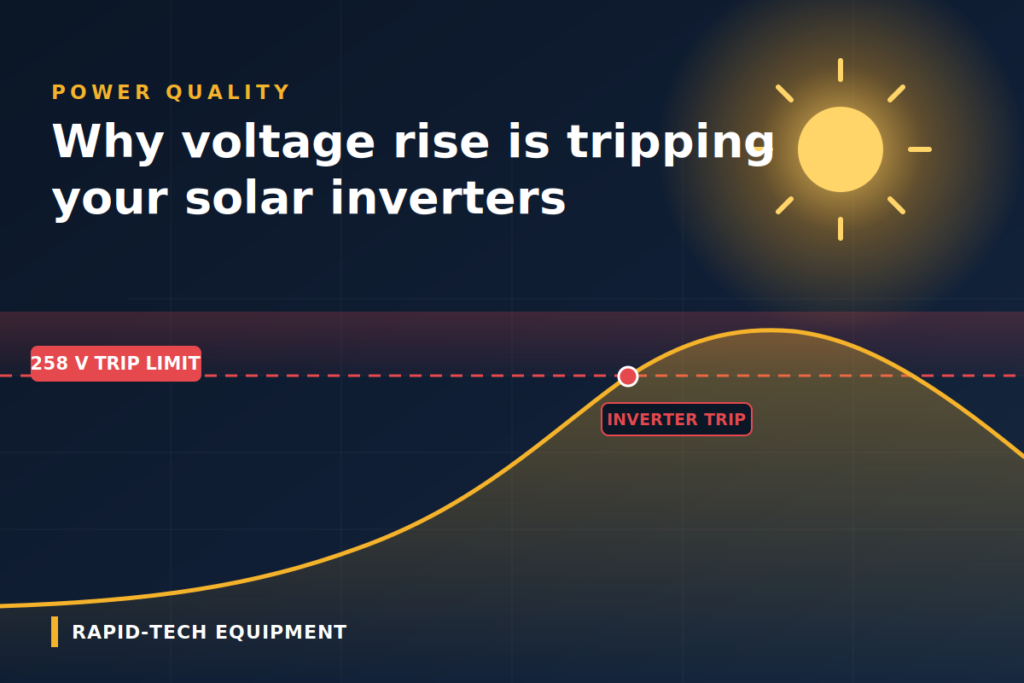
Why Voltage Rise Is Tripping Your Solar Inverters (And How to Prove It)
Quick answer: Solar inverters trip or derate when the AC voltage at their terminals climbs too high — typically when the 10-minute average exceeds 258 V under AS/NZS 4777.2. The cause is usually a combination of already-high grid voltage and voltage rise across the AC cabling between the inverter and the point of supply. The only way to prove which one is at fault — and get the network or the installer to act — is logged voltage data from a compliant power quality analyser.
The problem: lost generation, unhappy customers
It’s a familiar callout. The system worked fine in winter, but now on clear spring and summer days the inverter shuts down at midday, exactly when it should be producing the most. Or production is mysteriously down 10–20% with no fault codes at all — the inverter is quietly derating under its volt-watt response mode instead of tripping.
Either way, the customer sees a solar system that isn’t paying for itself, and the installer or maintenance contractor is the one who has to explain why.
What causes voltage rise?
When an inverter exports power, current flows from the inverter towards the grid. Every metre of cable between the inverter and the point of supply has impedance, so the voltage at the inverter terminals is always higher than the voltage at the street. Add these together and things get tight fast:
- High grid voltage to begin with. Australian networks supply 230 V nominal with an upper limit of +10% (253 V). In areas with heavy rooftop solar penetration, midday street voltages routinely sit near the top of that band.
- Voltage rise in the customer’s installation. AS/NZS 4777.1 limits voltage rise between the point of supply and the inverter AC terminals to 2% (about 4.6 V). Undersized cable, long runs to a shed or detached garage, or a loose termination can easily exceed this.
- Everyone exporting at once. On a sunny day, every system in the street pushes the local voltage up together — so the problem compounds at exactly the time of peak generation.
Start at 251 V at the street, add 5–8 V of rise across a marginal AC run, and the inverter terminals are past 258 V. The inverter is doing exactly what AS/NZS 4777.2 requires: derating, then disconnecting.
Trip or derate? Know the difference
- Volt-watt response: the inverter progressively reduces output as voltage climbs above the set threshold. No fault code — just quietly lower yield.
- Sustained overvoltage disconnect: if the 10-minute average voltage exceeds the limit (258 V for Australian settings), the inverter must disconnect and wait for the voltage to recover.
- Fast overvoltage trips: short excursions above the instantaneous limits cause immediate disconnection.
A system can be losing significant generation to volt-watt derating for months before it ever logs a single trip event — which is why inverter fault logs alone rarely tell the full story.
How to diagnose it properly
Guesswork doesn’t cut it here, because the fix depends entirely on where the voltage problem lives:
- Log at the point of supply for at least a week. Capture 10-minute average voltages through several sunny days. If the street voltage itself is exceeding 253 V, it’s a network problem — and your logged data is the evidence the distributor (DNSP) needs to investigate a transformer tap adjustment.
- Log at the inverter terminals over the same period (or in a second session). The difference between the two readings during peak export is your installation’s voltage rise. If it’s over 2%, the fix is on the customer’s side: upsize the AC cabling, shorten the run, or check terminations.
- Correlate with export current. Voltage rise scales with export power, so you want an instrument logging voltage, current and power together — not a multimeter spot-check at 3pm that misses the midday peak entirely.
For DNSP disputes and warranty claims, the data needs to be credible. That means an IEC 61000-4-30 Class A instrument with gapless recording — measurements taken to the same method the networks themselves use, so the numbers can’t be argued with.
The right tools for the job
HIOKI PQ3198 Power Quality Analyser — IEC 61000-4-30 Edition 3 Class A certified with gapless recording, capturing swells, dips, harmonics and transients simultaneously with trend data for up to a year. Its isolated fourth channel can measure the DC and AC sides of a solar system at the same time, so you can assess inverter behaviour and grid conditions in a single logging session.
Fluke 1770 Series Three-Phase Power Quality Analysers — a 2-in-1 troubleshooting meter and logging analyser with automatic measurement capture of 500+ parameters, guided setup, and simple reporting through Fluke Energy Analyze Plus. It can even be powered directly from the measurement circuit — handy at a switchboard with no spare outlet.
Only need an analyser for one job? Three-Phase Power Quality Analyzer – Fluke 1777 also available for rent through RentMyMeter
The PQ3198 is also available for through MyMeter — ideal for a one-off week of logging without the capital outlay.
What happens after the data is in
- Street voltage too high: lodge the logged data with the DNSP and request a supply voltage investigation. Networks act on Class A logged evidence far faster than on anecdotes.
- Excess voltage rise on site: quote the remediation with confidence — larger AC conductors, re-terminated joints, or a relocated inverter — and re-log afterwards to prove the fix.
- Settings issue: confirm the inverter’s region settings and volt-watt/volt-var curves match the DNSP’s connection requirements before touching anything else.
Talk to us
Rapid-Tech Equipment has supported Australian and New Zealand electrical professionals with test and measurement equipment for over 30 years. For help choosing a power quality analyser — or matching the right current sensors to your application — call us on 03 9763 3299 or email sales@rapid-tech.com.au.